


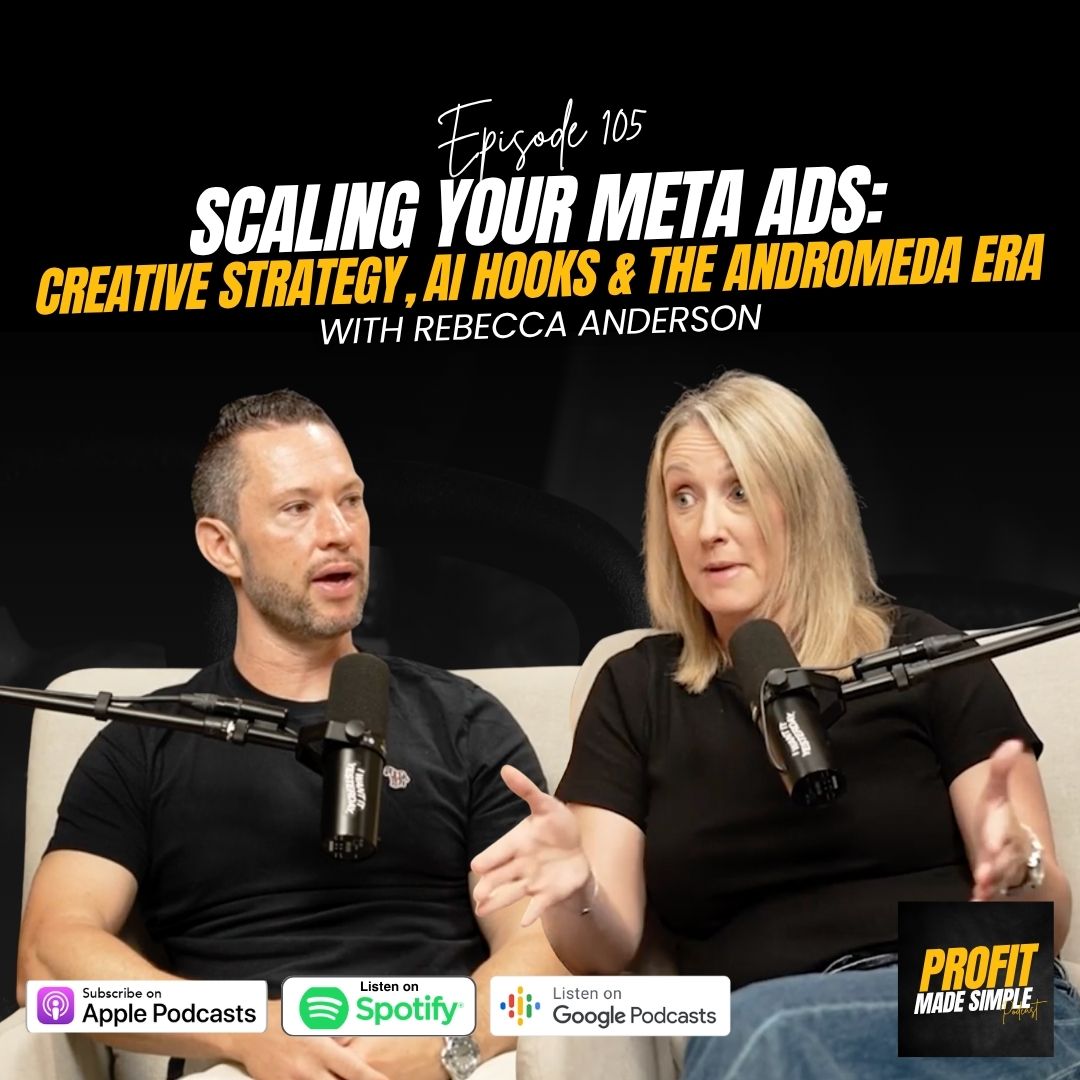
How to Win with Meta Ads in 2026 (Part 2): Creative, Targeting & What’s Actually Working
In part one of this series, we broke down the foundation of winning Meta ad campaigns in 2026:
- Your offer
- Your numbers
- And how to build a campaign that actually makes money
Now in part two, we go deeper into what most people think matters most:
The ads themselves.
The creative, targeting and setup.
And this is where most fitness business owners get it wrong.
Because while these elements are important, they only work when built on a solid foundation.
In this episode, I sat down again with Bec Anderson to unpack exactly what’s working right now on Meta and more importantly, what’s no longer working.
Let’s dive in.
The Biggest Shift: Meta’s AI (Andromeda) Is Changing the Game
One of the biggest changes inside Meta over the past 12 months is the push toward automation.
Specifically:
Broad targeting driven by AI.
Meta now believes it can find your ideal client based on:
- behaviour
- scrolling habits
- clicks
- past activity
In theory, this sounds incredible.
Let the algorithm do the heavy lifting.
But in practice?
It’s not working as well as people think.
The issue is simple.
When you go too broad, especially as a local fitness business, you lose control.
And instead of getting high-quality leads, you end up with:
- people outside your area
- people outside your demographic
- people who will never buy
That’s why even in 2026, you still need to guide the algorithm.
Not fight it but not blindly trust it either.
Creative Is More Important Than Ever (But Not in the Way You Think)
Let’s clear something up.
Creative is not the most important part of your campaign.
But it is critical.
Because even with a great offer, if your ad doesn’t stop the scroll, nothing else matters.
And this is where we’ve seen a massive shift.
What Good Creative Looks Like in 2026
The biggest change?
Polished is out and native is in.
Your ads need to look like they belong on the platform.
Not like an ad.
That means:
- no overproduced videos
- no corporate-style branding
- no stock footage
- no ‘perfect’ models
Instead, what works best is:
Real people. Real environments. Real content.
Content that feels like it was created by a normal person, because it was.
And the good news?
This levels the playing field massively.
Because now your ‘production studio’ is simply:
- your phone
- a basic mic
- a tripod
That’s it.
User Generated Content (UGC) Is Winning
If there’s one style of content dominating right now, it’s this:
User Generated Content (UGC)
This is:
- selfie-style videos
- raw gym footage
- real members training
- behind-the-scenes content
Why does it work so well?
Because it builds trust instantly.
People see themselves in it.
It doesn’t feel like marketing.
It feels real.
Video Is Non-Negotiable
If you’re still relying on static images alone, you’re already behind.
Every high-performing campaign right now includes:
Video.
And not just any video.
Simple, direct, human video.
According to Bec:
“Every ad that has a video will outperform everything else.”
That’s a bold statement but it’s backed by what we’re seeing across hundreds of accounts.
The 4 Creatives Every Campaign Should Have
One of the most practical frameworks shared in this episode was this:
Every campaign should include 4 types of creative.
1. The VSL (Video Sales Letter)
This is your most important asset.
It’s simply:
- you
- talking to camera
- explaining who you help and how
No fluff or overthinking. Just clear communication.
What makes this even more powerful is using a local landmark.
For example:
- filming outside a well-known café
- a local beach
- a train station
- a recognisable street
This creates instant familiarity.
It stops the scroll because people think:
‘That’s near me.’
2. VSL with B-Roll
This builds on your VSL by adding:
- footage of your gym
- people training
- community moments
It allows people to:
- connect with you
- see the environment
- visualise themselves there
Think of it as:
‘Here’s who we are and here’s what it looks like.’
3. UGC Image (Community-Based)
This is a simple image:
- real members
- real environment
- genuine energy
The best-performing ones usually show:
- small group training
- people smiling
- community vibe
And importantly:
People that look like your target audience.
4. Text-Based Image
Yes, these still work.
Even though people think they’re outdated.
Simple formats like:
- black background
- bold text
- high contrast colours (especially pink for female audiences)
They still grab attention because they’re clear and direct.
How to Structure Your Campaign
A simple structure that works:
- 1 campaign
- 1–2 ad sets (split by gender if needed)
- 4 creatives inside each
From there:
Let Meta optimise.
Give it 4–5 days to test.
It will naturally push budget toward the best-performing creative.
Your job is to:
- monitor
- kill what doesn’t work
- double down on what does
Hooks: The Difference Between Being Seen or Ignored
Once you have the creative, the next step is:
Your hook.
This applies to:
- your headline
- your opening line
- your first 3 seconds of video
And here’s the big shift:
Specific wins and generic loses.
Hyper-Niche Targeting Is Dominating
The more specific you are, the better your results.
Examples that are working right now:
- Over 35 strength programs
- Menopause programs
- Mums and bubs
- Youth development
- Over 60s fitness
These are what we call:
Blue ocean markets.
Less competition, more relevance and better results.
Generic offers like: 28 Day Kickstart are fading fast.
Long-Form Copy Is Back
Another interesting shift:
Long-form copy is outperforming short-form.
Why?
Because attention isn’t just about grabbing it.
It’s about holding it.
If someone reads your full ad, you’ve already built:
- trust
- authority
- connection
And that dramatically increases the chance they’ll click.
The key is simple:
Speak directly to their pain points.
Make it feel like:
‘This ad is about me.’
Lead Forms vs Landing Pages
We’re strong advocates of lead form ads.
Not because landing pages don’t work.
But because lead forms offer more control and better data capture.
With lead forms, you can:
- capture name, email, phone number
- build your database
- follow up even if they don’t buy immediately
Whereas with a landing page:
If they bounce, they’re gone.
How to Optimise Your Lead Forms
Meta has added some powerful features here.
To improve lead quality:
1. Use higher intent forms
This requires users to confirm their details before submitting.
2. Add qualifying questions
- multiple choice
- short answer
3. Use SMS verification
A one-time password ensures real contact details.
4. Use rich creative
You can now add:
- more images
- testimonials
- reviews
- additional copy
This turns your lead form into a mini landing page.
Targeting in 2026: What You Should (and Shouldn’t) Do
Here’s the simplified version.
What to do:
- set your location (within ~12 minutes of your gym)
- set your age range
- set your gender (if relevant)
What NOT to do:
- don’t use interest targeting
- don’t over-segment
- don’t overcomplicate
Meta is better at finding behaviour-based audiences than we are.
Budget: The Question Everyone Asks
There is no fixed number.
Your budget depends on:
- your cost to acquire a client
- your lifetime client value
- how many clients you want
- how fast you want to grow
And one more important factor:
Capacity.
Because one of the biggest problems we see is:
Too many leads.
Not enough systems to handle them.
Final Advice for Building a Winning Campaign
If you’re starting from scratch, keep it simple.
Here’s the blueprint:
- Start with a 28-day paid offer
- Create 4 strong creatives
- Use video (non-negotiable)
- Set up a high-quality lead form
- Choose ‘maximise conversion leads’
- Keep targeting simple
- Follow up relentlessly
Do that well, and you’re ahead of 90% of fitness businesses already.
Final Thoughts
Meta ads in 2026 are not harder.
They’re just different.
The businesses winning right now are not the ones doing more.
They’re the ones doing the right things better.
- Better offers
- Better targeting
- Better creative
- Better follow-up
Get that right, and you won’t just generate leads.
You’ll build a system that consistently grows your business.

Leave A Comment