


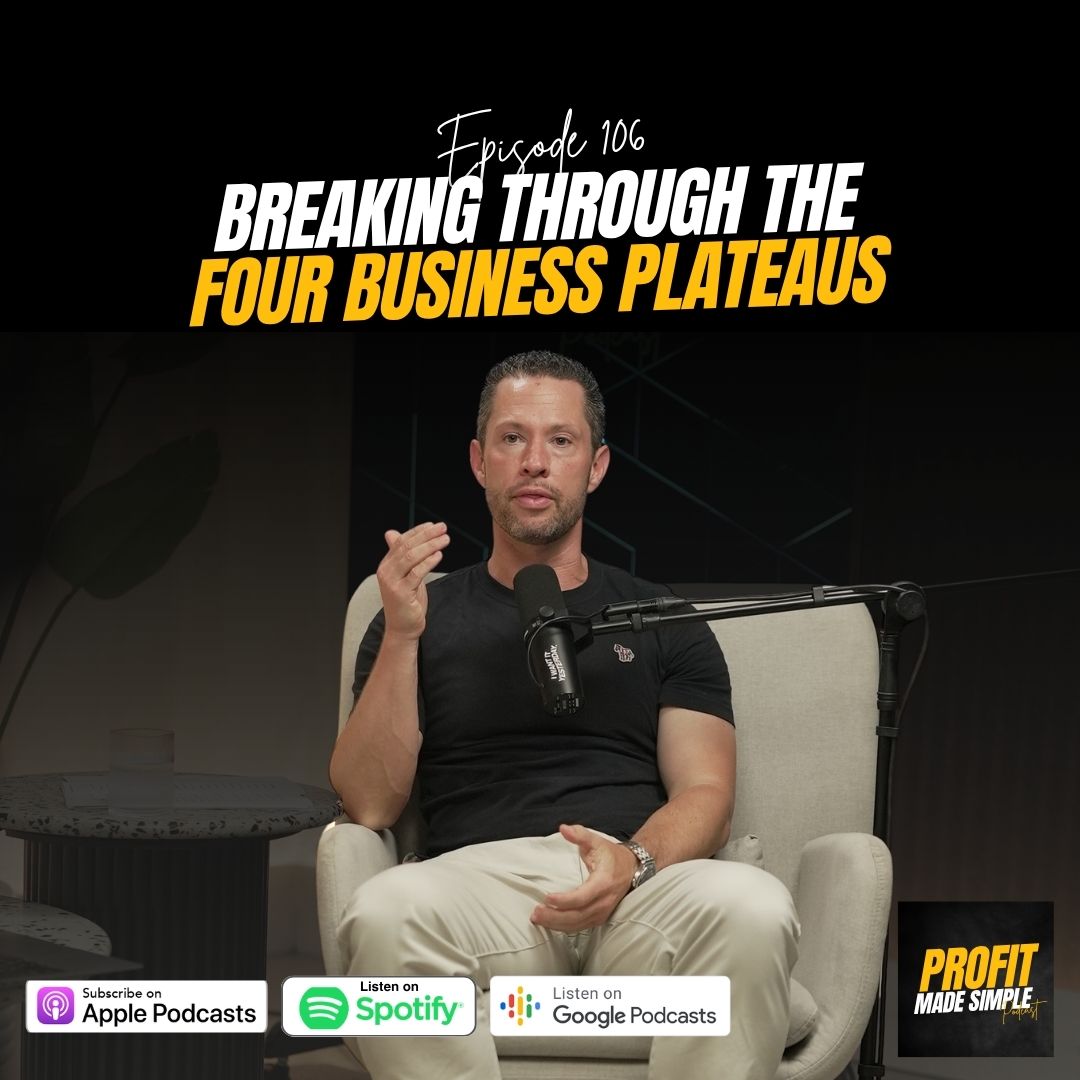
Why Your Business Feels Stuck (And How to Break Through Growth Plateaus at Every Stage)
If your business feels stuck right now, it is very easy to assume that something is broken.
You might feel like your marketing is no longer working, your team is not performing, or that you have simply hit a ceiling that you cannot push through. However, in most cases, none of that is actually true.
What you are experiencing is not failure, but a completely normal part of the business journey.
The reality is that business growth is not linear. It does not follow a smooth, upward trajectory. Instead, it happens in stages, and between those stages are periods where progress slows down, stalls, or even feels like it is going backwards.
These are what I refer to as growth plateaus, and every single business will encounter them multiple times.
The key difference between businesses that continue to grow and those that remain stuck is not effort, intelligence, or even opportunity. It comes down to one thing: the ability to recognise what needs to change at each stage and then execute on that change.
The Moment Everything Changed for Me
To understand this more clearly, I want to share a personal experience. I once owned an education business that, from the outside, appeared incredibly successful. We had built a strong reputation within the industry, partnered with major brands, and delivered workshops across 16 countries with a team of over 30 presenters. On paper, everything looked exceptional.
However, behind the scenes, the reality was very different. The business had become chaotic, and the cracks were starting to show. We were running close to 200 workshops per year, yet communication was breaking down. Participants were not always being notified properly, presenters were unclear on schedules, and leadership within the business had become entirely reactive.
The most confronting moment came during one of our weekly finance meetings. Despite generating multiple six figures in revenue each month, I was told that we did not have enough cash to pay our presenters or our team. That moment forced me to confront a hard truth: revenue alone does not create a sustainable business.
What got us to that point was a strategy of constantly adding more—more courses, more regions, more offers. While that approach initially drove growth, it eventually created complexity that the business could no longer handle.
The breakthrough came when we did the opposite. Instead of adding, we removed. We simplified the business, improved our systems, clarified roles, and strengthened communication.
The result was remarkable. Even during COVID, we experienced record-breaking months. That experience fundamentally changed how I view growth. It taught me that every plateau is not a problem to push through harder, but a signal that something needs to change.
Why Businesses Get Stuck
Every plateau exists for a reason. It is your business giving you feedback that the current version of you, your team, or your systems is no longer sufficient for the next level of growth. In my experience, the cause of these plateaus always falls into one of three categories.
The first is mindset, which includes the beliefs you hold about money, leadership, control, and your own capabilities. These beliefs can either empower your growth or quietly limit it.
The second is skill set, which refers to the capabilities required at each stage of business. The skills that help you start a business are not the same skills that help you scale it, and failing to evolve here will inevitably create friction.
The third is your toolkit, which includes your systems, processes, and technology. As your business grows, the level of sophistication required in your operations increases significantly.
At every stage of growth, at least one of these areas must evolve. Often, it is a combination of two or all three.
The Four Growth Plateaus
Over time, I have identified four distinct plateaus that every business moves through:
Survival, Capacity, Complexity, and Founder. Each stage presents its own challenges, and more importantly, requires a different version of you as a leader.
1. The Survival Stage
The survival stage is where every business begins, and it is often the most exhausting. At this point, you are working extremely hard just to generate momentum. You are likely wearing every hat in the business, from marketing and sales through to delivery and administration.
Emotionally, this stage can feel like a rollercoaster. When you gain a new client, you feel a surge of confidence and excitement. When you experience cancellations or slow periods, that confidence can quickly turn into doubt and anxiety. It is a very reactive phase, and it can be difficult to maintain consistency.
The biggest challenge here is not effort, because you are already working hard. The real issue lies in your mindset and skill set. Many fitness business owners enter the industry with a strong desire to help people, which is admirable, but this can sometimes lead to what I call a ‘martyr mindset.’ This is the belief that making money and helping people are somehow in conflict.
In reality, this belief is incredibly limiting. When you undercharge or fail to enforce your pricing, you restrict your ability to reinvest into your business and ultimately reduce the number of people you can help. Alongside this, many business owners at this stage lack the necessary skills in marketing and sales. Being a great coach is not enough if you cannot consistently attract and convert clients.
The breakthrough at this stage comes from shifting your beliefs around value and money, while simultaneously developing strong marketing and sales capabilities. Once you do this, you begin to see consistent growth, improved cash flow, and a growing belief that your business can succeed.
2. The Capacity Stage
As you move beyond survival, you enter the capacity stage. At this point, the business is generating revenue, clients are coming in more consistently, and you may even have a small team. However, a new challenge emerges: you are now the bottleneck.
You are still heavily involved in every aspect of the business. Even if you have team members, they rely on you for decisions, direction, and problem-solving. This creates a situation where everything flows through you, and as a result, your time and energy become the limiting factor for growth.
The core issue here is often a reluctance to relinquish control. Many business owners believe that tasks must be completed exactly as they would do them, which leads to micromanagement and inefficiency. This belief must change. You need to accept that having someone complete a task at 80% of your standard is often far more valuable than doing it yourself.
From a practical perspective, this stage requires the development of systems. You need clear processes, defined roles, and measurable outcomes for each position. Without these, your team cannot operate independently, and you remain stuck in the day-to-day operations.
The breakthrough comes when your business can operate effectively without your constant involvement. This is the point where you regain time and begin to experience what true business ownership feels like.
3. The Complexity Stage
The complexity stage is where many businesses experience significant growth, but also significant frustration. Revenue is increasing, the team is expanding, and from the outside, everything appears to be working well. However, internally, things begin to feel more complicated.
You may find that you have introduced multiple services, pricing options, and systems in an attempt to grow. While each addition may have made sense at the time, the cumulative effect is a business that is difficult to manage and difficult for your team to navigate.
The problem here is that growth has outpaced structure. The solution is not to continue adding more, but to simplify. This often requires making difficult decisions, such as removing services, consolidating offers, or restructuring your team.
In addition to simplifying the business, you must also develop stronger leadership skills. At this stage, your role is no longer to execute, but to make high-quality decisions, prioritise effectively, and lead your team with clarity and confidence.
When you successfully navigate this stage, you regain mental clarity and control. The business becomes easier to manage, and you create a foundation that allows for scalable growth.
4. The Founder Stage
The final stage is what I call the founder stage. At this point, you have built a successful business. It is profitable, well-regarded, and supported by a strong team. However, there is still one remaining constraint: you.
While your team may be highly capable, they are often implementers rather than leaders. They execute tasks effectively, but they still rely on you for direction, innovation, and strategic decisions. This creates a ceiling on the business, as its growth is ultimately tied to your capacity.
The breakthrough at this stage involves developing leaders within your organisation. This requires a shift in mindset, where you move from being the person who runs the business to the person who develops others to run it.
It also requires a new set of skills, particularly in coaching, mentoring, and leadership development. You must empower your team to take ownership, make decisions, and contribute to the evolution of the business.
When you achieve this, you unlock true freedom. The business is no longer dependent on you, and you have the flexibility to focus on higher-level strategy, new ventures, or personal pursuits.
The Most Important Takeaway
If there is one thing I want you to take from this, it is this:
Your business is not stuck. It is simply waiting for you to evolve.
Every plateau is an opportunity. It is a signal that you are ready for the next level, but only if you are willing to change. The question is not whether your business can grow, but whether you are prepared to become the person required for that growth.
What You Should Do Next
Take a moment to reflect on where you currently are. Identify which stage of the framework you are in and then ask yourself what needs to change. Is it your mindset, your skill set, or your systems? Once you have clarity on that, you can begin to take the necessary steps to move forward.
Because growth is not about doing more. It is about doing what matters at the right time.

Leave A Comment