


How to Win with Meta Ads in 2026
If you’re a fitness business owner and you want more leads in 2026, there is still one platform that gives you the greatest opportunity to generate them consistently and at scale….
Meta ads.
Yes, a lot has changed, and the platform is more complex.
We are also seeing many business owners struggling more than they were 6 to 12 months ago but that does not mean Meta ads have stopped working.
It simply means the rules of the game have changed.
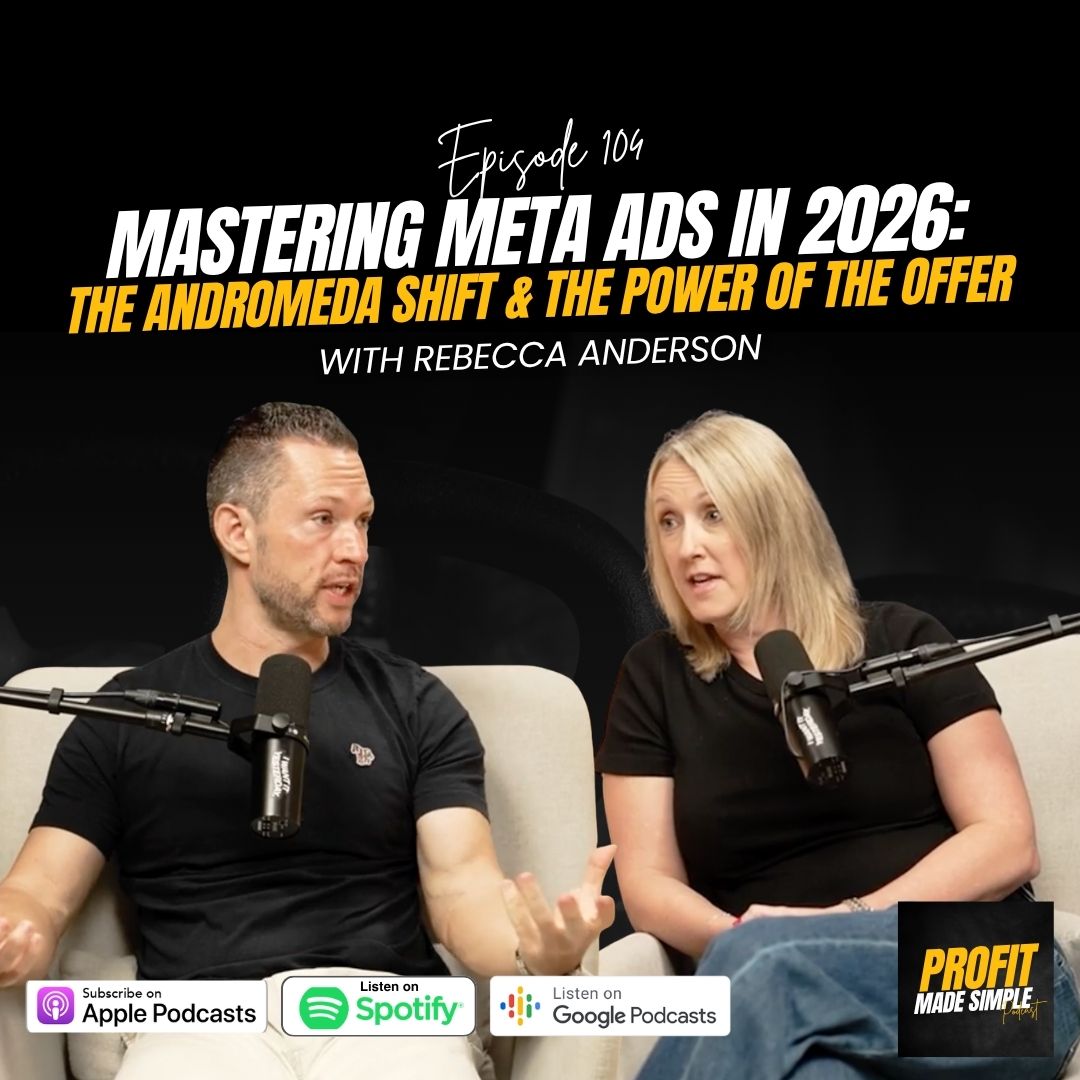
In this episode of Profit Made Simple, I sat down with returning guest Bec Anderson to unpack exactly what is happening inside Meta right now, why so many fitness businesses are getting poor results, and what you must do if you want your ads to work in 2026.
This is part 1 of a 2 part series, and in this article we’re focusing on the foundation of every successful campaign:
The offer and the numbers.
Because before you worry about headlines, hooks, creative, or AI-powered optimisation, you need to get these two things right.
If you don’t, your ads won’t work no matter how much money you spend.
Meta Ads Are Still the Best Lead Source for Fitness Businesses
One of the first questions I asked Bec was simple:
Are Meta ads still the number one way to generate leads for a fitness business?
Her answer was immediate.
“Without a doubt. 100%.”
That confidence doesn’t come from theory. It comes from being in ad accounts every single day, generating leads for fitness businesses and seeing those leads turn into real revenue.
So, if ads are still the best lead source, why are so many businesses frustrated?
According to Bec, the answer is clear.
Most people haven’t kept up with the changes.
Meta is a completely different platform now compared to what it was even nine months ago. The introduction of Andromeda, Meta’s AI-driven engine, has changed how ads are built, how audiences are targeted, and how campaigns are optimised.
In theory, Meta has tried to make the platform easier.
In reality, many fitness businesses are getting worse results because they are letting automation do too much, while ignoring the fundamentals that actually matter.
And that brings us to the first and most important lesson from this episode.
Your Offer Is the Foundation of Every Winning Campaign
If I could only teach one thing about Meta ads, it would be this:
A lot of leads will not fix a bad offer.
This is one of the biggest mistakes business owners make.
They think the problem is lead volume.
They say things like:
- “I just need more leads.”
- “Can you get me 20 leads next week?”
- “If I had more leads, everything would be fine.”
But if your offer is weak, generic, or unclear, more leads simply give you more people to follow up who were never likely to buy in the first place.
That creates frustration, wasted ad spend, poor morale in your team, and the false belief that Meta ads don’t work.
The truth is usually much simpler:
The ads are exposing a bad offer.
The 3 Types of Offers That Perform Poorly
Bec highlighted three offer types that consistently underperform.
1. Free trial offers
Free offers absolutely have their place, but for most boutique studios and independent fitness businesses, they are not the best fit for paid ads.
Why?
Because free attracts low commitment.
You tend to get:
- gym hoppers
- people chasing the next freebie
- low-intent leads who never planned to buy
The second issue is even more important.
Free trials create a cashflow lag.
You pay for the ads today, deliver the service now, and only hope to convert them later.
That means you are cashflow negative from the start.
For larger facilities with huge databases, full-time sales teams, and strong follow-up systems, free seven-day passes can still work.
But for most independent operators, a free offer on paid ads creates more stress than value.
2. Generic broad offers
If your offer tries to appeal to everyone, it will usually resonate with no one.
The vaguer the message, the more diluted the lead quality becomes.
Broad offers produce weak resonance, weak intent, and weaker conversions.
In 2026, fitness business owners need to be more targeted than ever.
3. Unclear offers
If the prospect doesn’t understand what they are getting, they won’t act with confidence.
You must answer questions like:
- What exactly is included?
- Is this group training, semi-private, or one-to-one?
- Do I get support?
- Is there accountability?
- Will someone guide me?
- What problem is this actually solving?
Clarity sells.
Confusion kills conversions.
The Best Offer in 2026: A Paid Low Barrier Entry Offer
The offer Bec kept coming back to was simple:
A paid 28-day low barrier entry offer.
This is what we call an LBE offer.
The reason it works so well is because it removes the biggest barrier for the prospect:
Long-term commitment.
It gives people a chance to dip their toe in the water, experience your community, see your coaching, and feel what it would be like to train with you long term.
28 days is the sweet spot because it’s:
- long enough for someone to get momentum
- long enough for someone to get a result
- long enough for someone to feel part of your culture
- short enough that it still feels safe
That’s a powerful combination.
And as Bec said, the best part is that the same 28-day experience can be wrapped in different ways depending on who you want to attract.
For example:
- 28 Day Reset
- Over 35 Strength Kickstart
- Master Menopause Program
- 28 Day Transformation
- Busy Mum Reset
- Return to Fitness Plan
The backend delivery can be very similar.
The wrapper changes based on the avatar.
That is one of the smartest and most practical lessons in this whole conversation.
The Low Barrier Is Time, Not Necessarily Price
This is an important shift.
Years ago, low barrier often meant cheap.
Now, in many cases, the smartest LBE offers are not cheap at all.
In fact, I would argue that in most cases you should price your LBE offer at the equivalent of what the training would actually cost over those 28 days.
Why?
Because when you discount too hard on the front end, you create a huge pricing gap between the trial and the ongoing membership.
That makes the transition awkward and harder to sell.
A stronger model is this:
- The offer is low barrier because it’s only 28 days
- The price still reflects the real value of what they’re getting
- The prospect is better qualified
- You attract people who are more ready to buy
- Your ad spend can be liquidated faster
That brings us to the next major lesson.
Liquidate Your Marketing
One of the best ways to think about your offer is this:
Can it liquidate your ad spend?
In simple terms, that means the money you collect from the 28-day paid trial covers or nearly covers the money you spent on ads to acquire the lead.
For example:
- You spend $210 on ads in a week
- You sell one 28-day offer for $249
You’ve now liquidated your ad spend and even made a small profit.
That matters because the more your front-end offer covers your acquisition cost, the more aggressively you can scale.
And the person who can spend the most usually wins.
If the gym down the street is running cheap or free offers, and you’ve built a front-end offer that self-liquidates, you can outspend them all day.
That is a huge strategic advantage.
The Number Most Business Owners Obsess Over (But Shouldn’t)
Most people fixate on cost per lead.
They’ll say:
- “My leads used to be $10.”
- “Now they’re $30.”
- “Ads are more expensive.”
- “Meta doesn’t work anymore.”
But cost per lead, on its own, is a vanity metric.
It matters, but only in context.
Because a cheap lead is not always a good lead.
You can absolutely get low-cost leads that:
- never answer the phone
- never show up
- never buy
- waste your team’s time
- tank your morale
Which is why the number that matters more is:
CAC — Customer Acquisition Cost
This is the real metric.
If you spend $210 on ads and convert one client, your CAC is $210.
That number tells you what it actually costs to get a paying client, not just an opt-in.
That is what matters.
The Number That Matters Even More: Lifetime Client Value
Once you know your CAC, the next number you need is:
LCV — Lifetime Client Value
This is the total value of a client over the life of their membership.
If a client stays with you for two years and spends $6,000 over that time, that is their lifetime value.
Now let’s say your CAC was $210.
You’d spend that all day to acquire a $6,000 client.
That’s why emotionally reacting to ad spend is dangerous.
If you don’t know your numbers, you’ll panic when costs go up.
If you do know your numbers, you’ll make smart decisions.
As Bec said, very few business owners actually know these metrics.
But once you do, your entire perspective on ads changes.
The Conversion Rates You Need to Watch
There are two key conversion points after the lead comes in.
1. Lead to trial
Bec’s benchmark here was around 15–25%, depending on lead quality and sales systems.
That means out of every 10 leads, you might convert 1 to 2.5 into your 28-day offer.
2. Trial to ongoing membership
The industry average is roughly 50%.
But our best-performing clients are achieving 75–90%.
That is a massive difference.
And it’s one of the biggest reasons two gyms can spend the same amount on ads and get wildly different outcomes.
How the Best Gyms Convert 75–90% of Trials
This doesn’t happen by accident.
The gyms that convert trials at a very high level do three things extremely well.
1. They roll out the red carpet
They don’t throw a new lead into a generic class and hope it works.
They create a real onboarding experience.
2. They follow up relentlessly
There are touchpoints after session one, after week one, after key milestones.
There is personal follow-up and automated follow-up working together.
3. They sell the full journey early
If someone has not bought emotionally by week three, you’re usually leaving it too late.
High-performing gyms create momentum fast.
They make people feel seen, supported, safe, and integrated into the community.
That is what drives conversions.
Follow-Up Is Still the Biggest Missed Opportunity
If there was one area where most businesses are leaving money on the table, it’s here.
Follow-up.
Bec was very clear on this.
Most people simply do not follow up enough.
Calling someone 2–3 times total and giving up is not follow-up.
That’s barely a start.
Her benchmark was:
- at least 9 points of contact in the first 3 days
- then another 8 over the following 4 days
That level of follow-up may sound intense to some people, but remember:
These are not cold leads.
These are people who raised their hand and asked for help.
They opted in, entered their details and expressed interest.
So, your job is to help them move forward.
The Role of Automation in 2026
If speed matters, and it does, then automation is no longer optional.
Because if you respond 30 minutes late to a lead, your effectiveness drops dramatically.
That’s why automation matters.
Not because it replaces the human.
But because it allows the human to respond fast, consistently, and professionally.
The best systems use:
- automation for speed and consistency
- personal follow-up for trust and conversion
That blend is where the magic happens.
The Real Goal of Meta Ads
The biggest takeaway from this episode is that Meta ads are not just about getting cheap leads.
They are about building a predictable acquisition system that works mathematically.
That means you need to understand:
- your offer
- your cost per lead
- your cost to acquire a client
- your conversion rate to trial
- your conversion rate to membership
- your lifetime client value
Once you know those numbers, ads stop feeling random.
They start feeling strategic.
And when they become strategic, they become scalable.
Final Thoughts
Meta ads are still the number one lead source for fitness businesses in 2026.
But the businesses winning right now are not the ones with the fanciest creative or the biggest ad budgets.
They are the ones who:
- have a strong paid offer
- understand their numbers
- follow up relentlessly
- build trust quickly
- and convert trials into long-term members
Get those pieces right, and Meta ads will still print money for your business.
In part two, we’ll go deeper into the actual ad platform itself:
- creative
- targeting
- Andromeda
- AI
and how to make the algorithm work in your favour
That’s where things get really fun.

Leave A Comment