


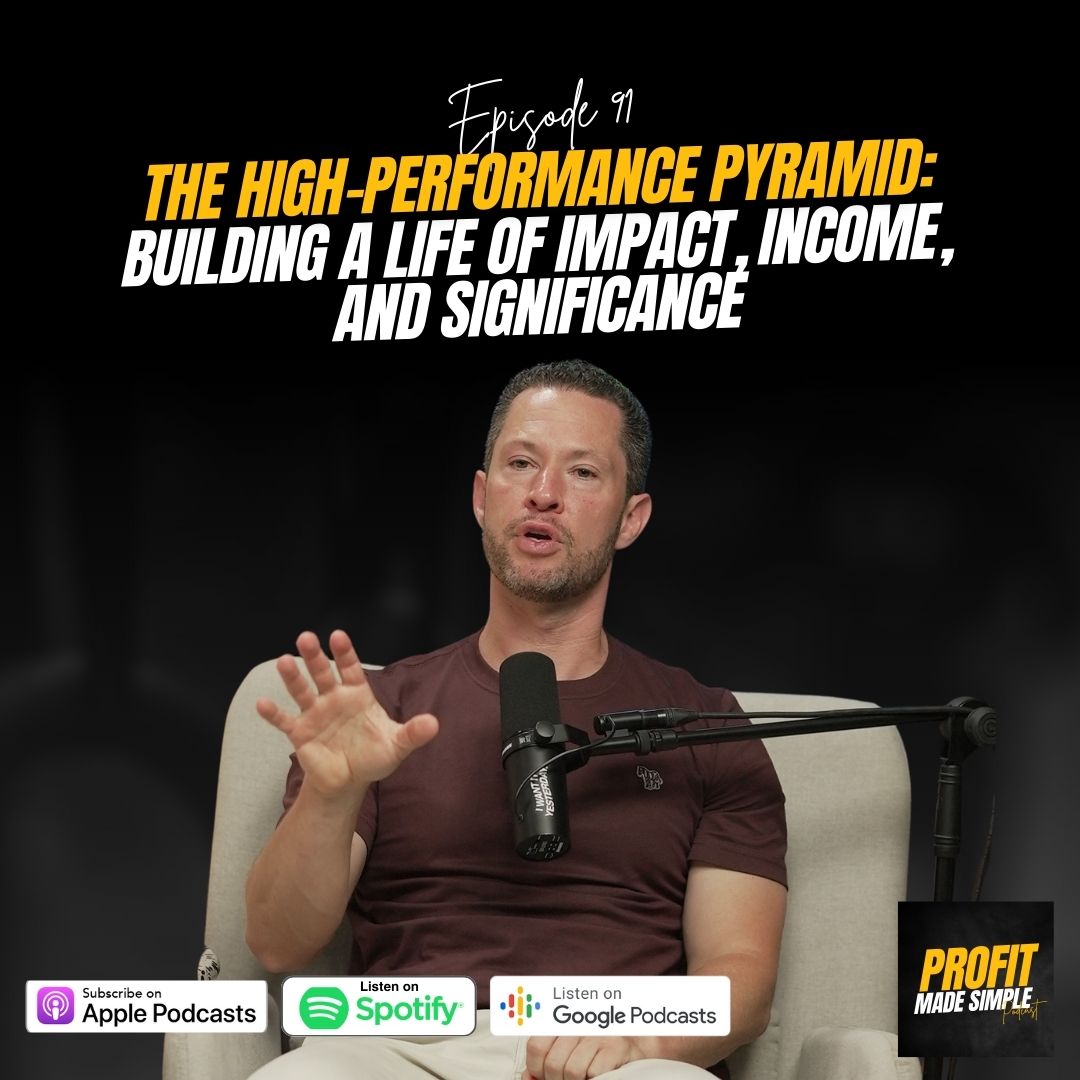
The High-Performance Pyramid: The Framework That Hits You Between The Eyes
Two weeks ago, I had the opportunity to present at the High-Performance Father Retreat at Mount Kosciuszko. It was a room full of men and dads who are committed to becoming better in 3 key areas: family, self and service.
I built a brand-new presentation for that room. Something simple, powerful and impossible to unsee once you hear it.
It’s called the ‘High-Performance Pyramid’, and in this episode I break it down so you can apply it to your life, your business and the legacy you leave behind.
This model is not about hustling harder.
It’s about aligning how you live, how you lead and how you show up when it matters most.
The Pyramid Starts with Standards
At the very base of the pyramid is standards.
Standards are the invisible rules that govern your life. They determine how you show up, and they are often how those closest to you would describe you.
Goals are important. They drive achievement and motivation.
But standards shape you.
And the hard truth is this: you can have very high standards in one area, and painfully low standards in another.
You can be dialled in with health…Training consistently. Tracking your food. Prioritising sleep. Wearing an Oura Ring. Doing the whole thing.
But then show up at home distracted, reactive and glued to your phone.
That gap is where relationships slowly erode.
So, the question is not whether you have standards.
You do.
The question is whether you have defined them deliberately in every key area of your life.
Examples of standards
- What time you wake up
- How much you use your phone
- The language and tone you use with your kids
- How often you train
- Your commitment to learning and growth
- How you transition from work into home
This part of the retreat hit a lot of men hard, because many of them had elite standards at work, but were giving their family the scraps.
And I have been there too.
Recently my partner gave me some hard feedback. She told me that when I come downstairs after working, I can be distracted, negative and not present. She said I wasn’t showing up as the person I thought I was.
She was right.
My standards had slipped with the people I care about most.
So, I created a ritual. A transition. Because if you do not transition intentionally, you bring work energy into home life, and it always leaks out somewhere.
Here’s what I changed:
- Phone goes in a drawer
- Deep breath work before I leave the office space
- Music if my energy is flat
- A simple prompt before I walk downstairs: How am I showing up and what energy do I want to bring right now?
The shift has been enormous.
Standards are the foundation. If the foundation is weak, everything above it becomes unstable.
The Second Layer Is Capacity
The next layer is capacity.
To give 100, you have to be 100.
Most people want to show up with energy and intention, but they are running on empty. They try to give 100 with only 20 in the tank.
That’s when you become stressed, overwhelmed, anxious and burnt out.
Capacity has three parts.
A. Physical capacity
This is the obvious one, but most people still ignore it.
If you sleep badly, the day is harder. If you do not train, your stress rises. If you eat poorly, your vibrancy drops.
Your capacity improves when you get four things right:
• Training regularly with strength work and aerobic conditioning
• Eating food that nourishes you and reducing processed foods, sugar and alcohol
• Down regulation that calms your nervous system, breathwork, journaling, mindfulness, sauna, cold exposure, NSDR
• Sleep, because nothing beats sleep for recovery
B. Emotional capacity
Tony Robbins was asked what the most important skill is for success.
His answer was emotional regulation.
When emotional capacity is low, everything becomes a trigger. A team member makes a small mistake, and you explode. A child spills milk and you react like it’s a crisis.
Stephen Covey says there is a stimulus and a response, and between them is your freedom to choose.
That freedom is your edge as a leader.
C. Mental capacity
This is your ability to think clearly, make decisions, be creative and act with decisiveness.
Most people destroy their mental capacity with constant noise. Phones. Scrolling. Bingeing content that does not build anything.
Mental capacity grows through white space. Reflection. Journaling. Time to think.
Capacity is not a luxury.
It is your responsibility to your family, your team and yourself.
The Third Layer Is Service
Above standards and capacity sits service.
Service matters. It is where you contribute. It is where you lead. It is where you build a business that creates impact.
But here’s the trap.
Many people put service first. They sacrifice standards and capacity because service is where the applause is loudest. It is where the validation comes from. It is where the recognition lives.
That is how people burn out while still looking successful from the outside.
Service is not just work. It is how you show up for your family. How you show up for your community. And how you show up for yourself.
A powerful reminder from the episode is this:
Validation is a hole you fall into. Service is a path you walk.
So, ask yourself: Are you serving for approval, or are you serving from alignment?
And another question that changes everything: What would your service look like if your standards were locked in and your capacity was full?
That version of you already exists.
The Top of the Pyramid is Significance
At the very top is significance.
Significance is not what you achieve. It is what you become.
It is what your family and community will remember long after the titles, revenue and trophies fade.
This is where the episode lands with force: we often confuse success with significance.
Success vs significance
- Success is external, significance is internal
- Success is visible, significance is felt
- Success is measurable, significance is remembered
- Success is achievement focused; significance is character focused
- Success is income focused; significance is presence focused
- Success is titles, significance is tone and energy
- Success is reputation, significance is consistency
- Success is external validation; significance is how you handle pressure
- Success is applause, significance is legacy
So which side have you been living on?
How To Apply the High-Performance Pyramid
To make this practical, here is the action challenge from the model.
- Set your standards
Choose at least three standards across the key areas of your life. Health, relationships, family, business.
- Build your capacity
Pick one physical habit, one emotional habit and one mental habit to strengthen in the next 30 days. - Audit your service
Is your work aligned to your values, or is it driven by validation? - Define significance
How do you want to be remembered by the people closest to you?
If you do this honestly, you will not just perform better. You will live better.
And that is the entire point.



Leave A Comment