



10 Fitness Business Mistakes That Are Costing You Growth
I spend most of my working life talking to fitness business owners. Some run large gyms with hundreds of members and a sizeable team, while others own boutique studios, personal training businesses or smaller facilities they’re trying to grow. The businesses can look completely different from the outside, but after enough conversations you start noticing that the same problems appear repeatedly.
What’s interesting is that a lack of effort is rarely the issue. Most fitness business owners I meet work incredibly hard and, in many cases, they’re working far harder than they should be. The problem is often where that effort is being directed. They’re solving the wrong problem, avoiding a decision they know needs to be made or continuing to operate the business in a way that worked three years ago but no longer works today.
In a recent solo episode of ‘Profit Made Simple’, I shared 10 of the biggest fitness business mistakes I’m seeing right now. Some relate to pricing and profitability, others to retention, leadership, systems and technology, but they all have one thing in common. Left unaddressed, they can quietly put a ceiling on an otherwise good business.
You probably won’t be making all 10, but I’d be surprised if you didn’t recognise yourself in a few of them. The objective isn’t to walk away with 10 more things for your to-do list. It’s to identify the one or two that are currently having the biggest impact on your business and start there.

Why Good Fitness Businesses Still Get Stuck
There is a point in almost every fitness business where working harder stops being the answer. When you’re starting out, effort can compensate for a lot. You can coach the sessions, answer every lead, write the programmes, create the content, clean the gym and chase overdue payments because the business is still small enough for you to keep most of it in your head.
Then you grow, and what worked at 50 members starts breaking at 150. There are more staff, more members, more money moving through the business and far more opportunities for things to go wrong. Decisions become more expensive, your time becomes more valuable and inefficiencies that once seemed insignificant can start costing you thousands of dollars.
This is where owners have to make the transition from being good fitness professionals to becoming good business operators. That doesn’t mean losing the passion that got you into the industry. It means recognising that the skills required to coach 20 people brilliantly aren’t necessarily the same skills required to build a profitable business that serves 300.
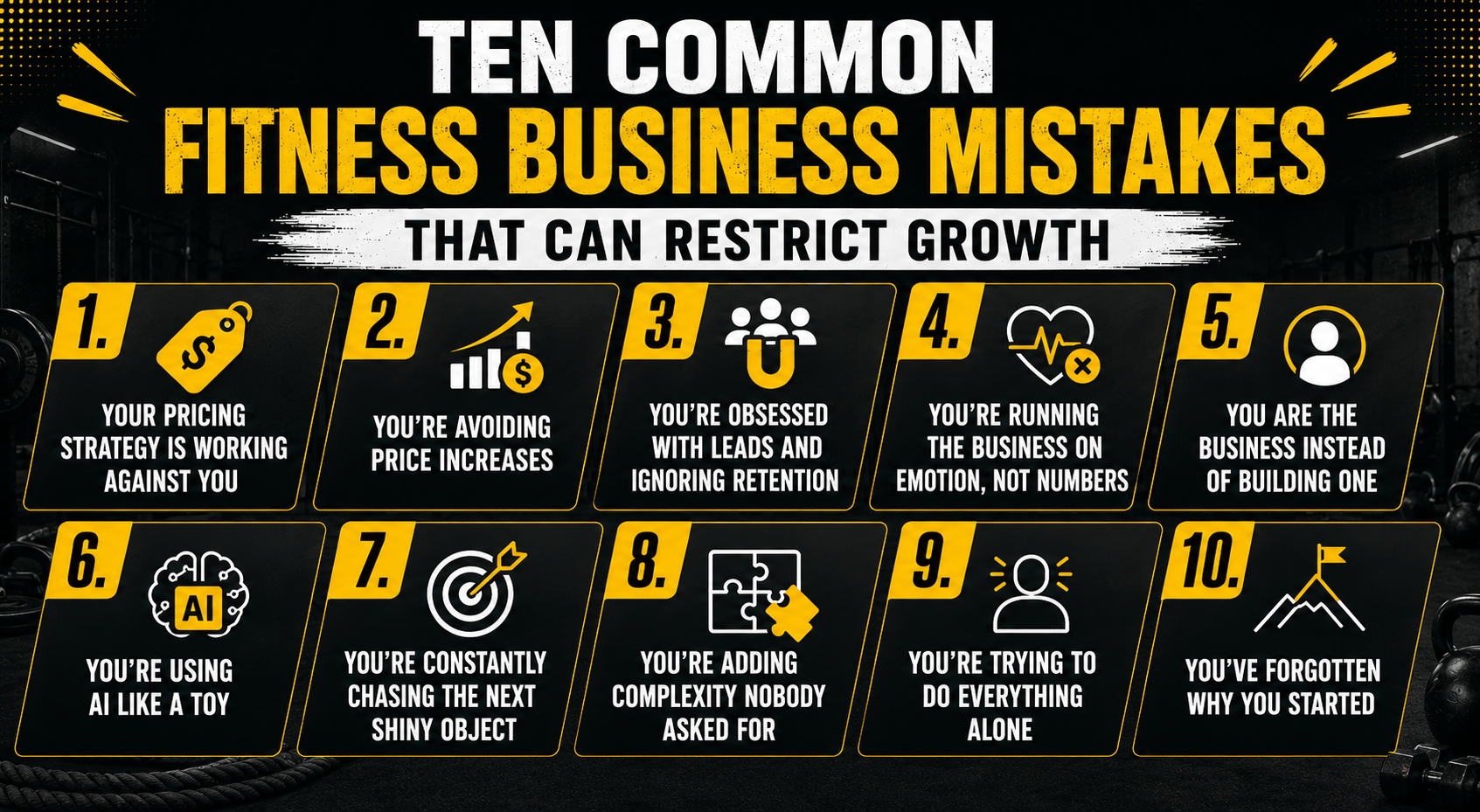
With that in mind, these are the ten mistakes I’d be looking at first.
1. Your Pricing Strategy Is Working Against You
Whenever I speak with a fitness business owner who’s considering joining one of our programmes, pricing and packaging is one of the first places I look. It’s often the lowest hanging fruit in the business because you can sometimes make relatively small changes without adding another member and create a significant improvement in profitability.
One of the most common problems is too much choice. The business has casual visits, packs, 2 sessions per week, 3 sessions per week, 4 sessions per week and unlimited training. Then each of those might have month-to-month, six-month and 12-month variations. The owner thinks they’re being flexible and giving the prospect every possible option, but the prospect often experiences something completely different. They’re being asked to make a decision they don’t understand.
I prefer having a clear core offer. Your main team-training membership might be unlimited training at one price for a six-month commitment, with a slightly higher price if somebody wants greater flexibility. You can still have another membership available for someone who genuinely tells you they’ll only train twice per week, but it doesn’t necessarily need to be presented alongside 7 other options during the initial sale.
There’s an important distinction here. You can have more options without presenting more options. Your job during the sales process isn’t to demonstrate how many memberships you’ve created. It’s to make it easy for somebody to choose the solution that’s most likely to help them.
The other pricing mistake is allowing the gym down the road to determine what you charge. Owners tell me they can’t charge more than a particular amount because that’s what everybody else in their suburb charges, but the moment you accept that logic you’ve started treating your service like a commodity. I’d much rather compete on the problem you solve, the results you produce, and the experience members receive than find myself in a race to see who can charge $5 less each week.
I’d also look beyond the base membership and consider lifetime value. If the average member currently spends $3,000 with you over the course of a year, are there additional services that would genuinely help them achieve a better result? That could be semi-private personal training, nutrition coaching or another relevant service. Increasing the value of an existing relationship can sometimes be a far better growth strategy than constantly searching for another lead.
2. You’re Avoiding Price Increases
I’ve spoken about price increases so many times that I sometimes feel like a broken record, yet it remains one of the decisions fitness business owners avoid for far too long. They worry that members will leave, remember a promise they made to foundation members 5 years ago or convince themselves they’ll revisit pricing when the economy improves.
Meanwhile, almost every meaningful cost inside the business continues moving in the other direction. Rent goes up, wages increase, insurance costs more, software subscriptions rise and the cost of delivering a great service gradually increases. If membership prices remain unchanged indefinitely, your margins don’t remain unchanged with them.
That’s why I believe pricing should be reviewed regularly rather than treated as something you set when you open the doors and never touch again. Within our coaching community, we routinely look at whether increases in the region of 8 to 10 percent are justified, but that isn’t a blanket rule for every fitness business. The right decision depends on your current price, costs, margins, market and the value you’re delivering.
The mistake is allowing fear to make the decision for you. Yes, it’s possible that a small number of members may leave following an increase, and that can feel uncomfortable when you know those people personally. You still need to assess the outcome across the entire membership base rather than deciding the strategy failed because two people cancelled.
Price increases should be thoughtful, justified and communicated well, but refusing to increase prices indefinitely isn’t a strategy. Eventually, it simply becomes a decision to accept lower margins.
3. You’re Obsessed With Leads and Ignoring Retention
Ask a struggling gym owner what they need and there’s a good chance the answer will be “more leads.” Sometimes they’re absolutely right, but before I spend more money trying to pour people into a business, I want to know how quickly people are disappearing out the other side.
I’ve had countless conversations with owners who tell me their retention is great. When I ask what their monthly churn is, they don’t know. That’s the problem. We can’t manage retention based on how busy the gym feels or whether we can remember many people cancelling recently. We need to know the number.
As a practical benchmark, if a business is consistently losing more than around 5 percent of its membership each month, I’d want to investigate what is happening before becoming overly aggressive with acquisition. That doesn’t mean 5 percent is a universal line that applies to every business model, but sustained churn at that level deserves attention because you’re being forced to replace a meaningful part of your membership base just to stand still.
The next question is where the problem actually sits. It could be onboarding, inconsistent coaching, poor attendance, a lack of progress or members simply failing to build relationships within the business. Sometimes nobody notices when a member who used to train four times per week suddenly hasn’t attended for 12 days.
Marketing matters enormously, but acquisition becomes expensive when you’re continually paying to replace people who should still be members. I’d much rather build a business that’s good at bringing people in and gives them plenty of reasons to stay.
4. You’re Running the Business on Emotion, Not Numbers
One of the clearest differences I see between businesses that remain stuck and those that become genuinely scalable is how well the owner understands the numbers. The stronger operators know what it costs to generate a lead, what it costs to acquire a member, how effectively their team converts enquiries, how many trials become memberships, what percentage of members leave each month and approximately how much a client is worth over the lifetime of the relationship.
Knowing those numbers changes the way you make decisions. Imagine you spend $300 acquiring a new member. If you don’t understand your economics, watching $300 disappear into a Meta campaign can feel expensive and you might turn the campaign off. If you know that the average member is worth several thousand dollars to your business over their lifetime, you can assess that $300 very differently.
A particularly useful relationship to understand is lifetime value compared with customer acquisition cost. As a general principle, I like to see at least a 3:1 relationship between the two, although the appropriate ratio depends on your margins, cash flow and business model. The point isn’t that every fitness business must hit an arbitrary benchmark. The point is that you should know what your numbers are and what they mean.
Without that information, business becomes emotional. A quiet sales week feels like a disaster, one cancellation feels more important than the broader retention trend and an advertising campaign gets judged based on how much money left the bank account rather than what it generated in return. Numbers don’t remove uncertainty from business, but they give you a much better foundation for making decisions.
5. You Are the Business Instead of Building One
This is one of the mistakes that concerns me most because I’ve seen where it eventually leads. The owner coaches the most sessions, writes all the programming, responds to every important client question, handles the marketing, sells the memberships, manages the team and sometimes still cleans the gym. If they disappear for a week, half the business seems to disappear with them.
In the early stages, that level of involvement can be necessary. The problem is when it becomes permanent. What initially felt like commitment and control gradually turns into a business that can’t operate without you, and that’s when owners find themselves exhausted despite having built something that looks successful from the outside.
The objective isn’t necessarily to remove yourself completely. Plenty of fitness business owners love coaching, and if you genuinely want to coach a few sessions each week, I think that’s fantastic. The important word is choice. You should be coaching because you enjoy it or because that’s where you create the greatest value, not because Tuesday’s 6am class gets cancelled if you don’t turn up.
Getting to that point requires you to progressively remove yourself from tasks other people can perform. You’ll need clear systems, capable team members, documented expectations and leaders you trust to make decisions. That process can feel uncomfortable, particularly if you’re used to believing nobody will ever do things quite as well as you do, but the alternative is accepting that the business can never become bigger than your personal capacity.
6. You’re Using AI Like a Toy
There are fitness business owners using AI to ask ChatGPT to write an Instagram caption, and there are fitness business owners using AI to fundamentally improve how their company operates. Both are technically “using AI”, but the difference in potential value is enormous.
I’ve dedicated entire Profit Made Simple episodes to AI because I think the opportunity for fitness businesses goes well beyond content creation. We’re already seeing businesses use AI to help surface important numbers from dashboards, analyse information inside a CRM, assist with sales follow-up, confirm bookings, review sales conversations and create more efficient content workflows.
For me, the question isn’t how we use technology to remove people from fitness businesses. The human element is one of the biggest reasons people choose a great gym or studio in the first place. Coaches build relationships, understand context, create community and notice things about members that software can’t replicate particularly well.
The opportunity is to remove repetitive work that stops those people doing the things they’re best at. If a member of your team spends five hours every week moving information between systems, producing the same reports or completing basic administrative tasks, that’s where I’d start looking for leverage.
Instead of asking, “What can AI create for me?”, ask what repetitive work is consuming time inside your business and whether technology could help you do it faster or better. That’s a much more useful conversation.
7. You’re Constantly Chasing the Next Shiny Object
Fitness business owners are surrounded by new ideas. Every week there’s another marketing strategy, social platform, challenge, offer, piece of software or business guru telling you the thing you’re currently doing is outdated. It’s very easy to spend your entire year changing direction without ever giving one strategy enough time to work.
You see a competitor running a six-week challenge and decide you need one. Two weeks later somebody tells you YouTube is the future, so your attention moves there. Then TikTok becomes the priority, followed by a new referral campaign and a completely different target market. There is nothing inherently wrong with experimenting, but constant experimentation without a stable foundation creates a business that is always starting and rarely finishing.
When I look at some of the strongest operators in our community, including businesses generating seven figures in annual revenue, I’m often struck by how unexciting their success looks from the outside. They create content consistently, follow up leads, have sales conversations, contact members who haven’t attended, review marketing campaigns, develop their staff and keep doing the work long after the initial excitement has disappeared.
That’s not an argument against innovation. Good businesses should test new ideas, but those experiments should sit on top of a consistent operating rhythm rather than replacing it every fortnight. The boring things that work are still allowed to work simply because they’re boring.
8. You’re Adding Complexity Nobody Asked For
As businesses grow, owners tend to add things. Another membership option, another app, another coaching call, another session type, another dashboard and another feature that we hope will make the service feel more valuable. The intention is usually good, but the member can experience all that additional value as complexity.
Imagine being a new client and discovering you have 60 sessions to choose from, three apps to download, a portal to log into, a coaching appointment to schedule and several different membership features you don’t really understand. The owner sees an incredibly comprehensive service. The member may simply wonder which parts they’re supposed to use.
Complexity causes problems internally as well because everything you add needs to be explained, delivered, maintained and eventually taught to new team members. That’s one reason I believe simplicity scales so well. A simple business isn’t necessarily a basic business. It is a business that has been deliberate about what belongs and disciplined enough to leave out what doesn’t.
Before adding something new, I’d ask whether it genuinely improves the member’s result or experience, whether people will actually use it and whether your team can deliver it consistently. If the answers aren’t clear, adding another feature may make the business worse rather than better.
9. You’re Trying to Do Everything Alone
There’s an interesting contradiction in our industry. We spend our careers telling clients they’ll achieve better results with coaching, accountability, structure and support, then many of us attempt to build our own businesses without any of those things.
Running a fitness business can be surprisingly isolating. Your employees shouldn’t have to carry every pressure you’re dealing with, your members certainly shouldn’t, and friends or family may care enormously about you without understanding what it’s like to manage cash flow, staff issues, sales targets and cancellations at the same time.
That’s why I think having the right people around you matters. It could be a business coach, mentor, industry group or a handful of other operators you trust. I recently spent time with more than 30 of our Sydney clients and one of the comments I heard repeatedly was how valuable it was simply being around people dealing with similar challenges. Sometimes knowing that somebody else has faced the same problem, and hearing how they worked through it, gives you the perspective you weren’t able to find on your own.
I’m obviously a fitness business coach, but I’m not suggesting everybody reading this needs to hire me. What I am saying is that trying to figure out every problem yourself is an unnecessarily expensive way to learn. Somebody has probably already made the mistake you’re about to make, and there is a lot of value in learning from them before you pay the same tuition fee.
10. You’ve Forgotten Why You Started
Nobody accidentally starts a fitness business. At some point, you decided to create something that didn’t exist before. Maybe you believed people deserved a different training experience, fitness had changed your own life or you saw a group of people who weren’t being served properly. Perhaps the motivation was more personal and you wanted to create greater freedom for yourself and your family. Whatever the reason, there was something that made starting the business worth the risk.
Then the realities of running a business gradually took over. Payroll, timetables, marketing, staff issues, cancellations, broken equipment and rent became the things demanding your attention every day. There’s nothing unusual about that, but over time it’s surprisingly easy to become so consumed by operating the business that you lose connection with why you built it in the first place.
That’s worth revisiting occasionally. Profit, systems and growth obviously matter, but they’re supposed to help you create the business and life you wanted in the first place. There’s little point building a financially successful fitness business if you eventually create something you no longer enjoy owning.
You don’t need an inspirational mission statement on the wall to reconnect with your purpose. You simply need some clarity around what you’re actually trying to build, why it matters to you and whether the decisions you’re making today are moving you closer to it.
Frequently Asked Questions
What are the most common fitness business mistakes?
Some of the most common fitness business mistakes include underpricing services, presenting too many membership options, focusing heavily on lead generation while ignoring retention, failing to track key financial and sales metrics, creating a business that depends entirely on the owner and continually changing strategies before they have enough time to work.
How can I make my gym more profitable?
Start by understanding where the business currently makes and loses money. Review your pricing, margins, retention, client lifetime value and customer acquisition costs before assuming you simply need more members. In some businesses, a sensible price adjustment or improvement in retention can have a greater impact on profit than generating another 50 leads.
How often should a gym increase membership prices?
I believe gym owners should review pricing at least annually, but reviewing your price doesn’t automatically mean increasing it. The decision should consider your operating costs, current margins, market, service improvements and the value members receive. The mistake is leaving prices unchanged for years without ever reviewing whether the economics still work.
What numbers should a fitness business owner track?
At a minimum, I’d want to understand revenue, profit, cost per lead, customer acquisition cost, sales conversion rate, trial-to-membership conversion, monthly churn or attrition and average client lifetime value. You don’t need 100 metrics on a dashboard, but you do need enough information to understand how effectively the business is acquiring, converting and retaining members.
What is a good gym member retention rate?
There isn’t one perfect retention number for every gym model, but you should know your monthly churn and monitor the trend. As a practical operating benchmark, I’d investigate closely if a business was consistently losing more than around 5 percent of its membership each month, particularly if acquisition is being used primarily to replace departing members.
How can I make my gym less dependent on me?
Start by identifying the tasks that genuinely require your skills and those you’ve simply become accustomed to doing. Document repeatable processes, establish clear standards and progressively give capable team members responsibility for delivery and decisions. The goal isn’t necessarily to remove yourself from the gym, but to reach a point where your involvement is a choice rather than a requirement.
How can AI help a fitness business?
AI can help with reporting, CRM analysis, sales-call reviews, appointment administration, content workflows and repetitive communication tasks. I’d prioritise applications that save your team meaningful time or provide information that helps you make better decisions rather than adopting AI simply because it’s new.
Do fitness business owners need a business coach?
Not every owner needs a paid business coach, but most benefit from having experienced people around them. That support could come from a coach, mentor, peer group or industry community. The real value is access to perspective, accountability and lessons learned by people who have already dealt with the problems you’re currently trying to solve.
Final Thoughts
When you look at these ten fitness business mistakes together, there’s a common theme. Sustainable growth rarely comes from discovering one extraordinary marketing tactic or making one huge change. More often, it comes from getting the fundamentals right and continuing to improve them as the business grows.
That might mean simplifying your pricing rather than creating another membership, reviewing your prices instead of accepting shrinking margins, or putting as much attention into retention as you currently put into lead generation. It might mean finally learning your numbers, handing responsibility to somebody else or removing systems and services that have made the business unnecessarily complicated. For other owners, the biggest change may simply be finding the right people to learn from and reconnecting with what they wanted the business to give them in the first place.
The fitness businesses I see achieving sustained growth aren’t constantly searching for secrets. They’re usually very good at doing the important things consistently, measuring whether they’re working and making deliberate changes when the evidence tells them something needs to improve.
If you’ve read this article and recognised yourself in four or five of these mistakes, resist the urge to attack all of them tomorrow morning. Work out which one is currently costing your business the most money, time or opportunity and fix that first. Once you’ve made meaningful progress, move on to the next one.
That’s a much more sustainable way to build a better fitness business.



Leave A Comment