


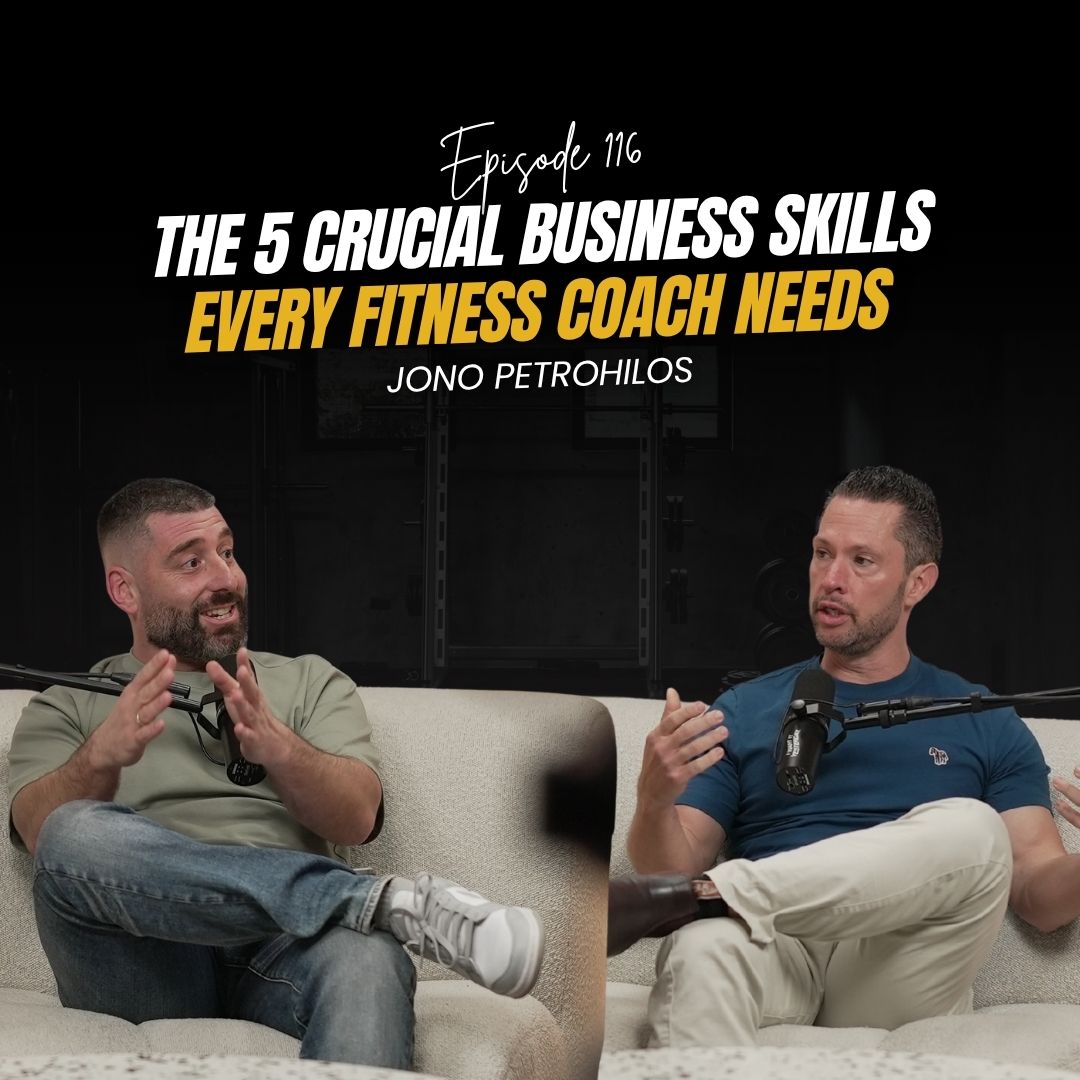
What Fitness Professionals Get Wrong About Growing Their Business — Lessons from Fitness Education Online’s Jono Petrohilos
One of the most enjoyable episodes we have done on Profit Made Simple in a long time. Jono Petrohilos from Fitness Education Online came back on the show for the first time since our very first episode, and instead of a standard interview format, we did something completely different. Blind rankings. Five categories, five options each, ranked from least to most important. No script, no prep, just honest opinions from two people who have spent a long time in this industry.
What came out of it was genuinely useful. Not just the rankings themselves, but the reasoning behind them. The nuance. The parts where we agreed, the parts where we pushed back, and the moments where a simple ranking question opened up a much bigger conversation about what actually drives success for fitness professionals and business owners.
Here is what we covered.
How Experienced Fitness Professionals Should Actually Be Learning
The first ranking was around the best ways for an experienced fitness professional to upskill and grow. The five options were online courses, podcasts, conferences, mentorship, and working under a great coach. Jono ranked them from least to most valuable for someone who is already experienced in the industry, and his reasoning was sharp throughout.
Podcasts came in last for experienced professionals, though Jono was quick to clarify that this was context-specific. For someone just starting out, podcasts are genuinely valuable. They are free, accessible, and a great way to explore ideas and follow threads of curiosity. But for an experienced professional looking to master a specific skill, podcasts are more background noise than deep learning. You consume them while driving or training, not when you are trying to close a genuine knowledge gap.
Online courses landed at number four for similar reasons. The further along you are, the more likely you already know ninety percent of what any given course covers. You might pick up the remaining ten percent, but there are faster and more efficient ways to get there. Jono’s point was not that courses are bad. It was that their value is highest early on and diminishes as your baseline rises.
Conferences came in at three, and this is where it got interesting. Jono goes to conferences every year, including travelling to the United States annually to attend events. But he does not go primarily to learn. He goes to network, to see what other operators are doing, and to identify gaps in his own business that he then addresses through other means. For experienced professionals, most conference content sits below your current level. The real value is in the conversations happening in the hallways, not the sessions on stage.
Working under a great coach landed at number two. The reasoning here was compelling. When you work alongside or under someone who is operating at a high level, you get exposed to what you do not know you do not know. You can identify a course to fill a gap you are aware of, but you cannot identify a gap you cannot see. Proximity to excellence reveals those blind spots in a way that structured learning rarely does.
Mentorship came in at number one, and Jono summed it up well. Find someone who has spent ten years mastering a skill and compress that into ten weeks. You might not absorb all of it, but you will absorb far more than most people ever will, and you save yourself years of trial and error in the process. He gave three concrete examples from his own career where targeted mentorship, on email marketing, Facebook ads, and phone sales, produced immediate returns and skills he still draws on more than a decade later.
The Biggest Threats to Personal Trainers Over the Next Five Years
The second ranking looked at what poses the greatest risk to personal trainers going forward. The five options were AI, GLP-1 medications, cost of living, poor industry standards, and online courses and apps. The results were more nuanced than most people in the industry would expect.
AI came in last as the lowest perceived threat, which will surprise a lot of people. Jono’s reasoning was straightforward. A personal trainer and an AI-generated program are simply not the same product. The people who use AI to get a training plan are largely people who would never have hired a personal trainer in the first place. They were googling programs before and they are using AI now. The human relationship, the accountability, the coaching in the moment, none of that is replicated by a language model. The advice for trainers was to work with AI rather than fear it.
Online courses and apps came in fourth for the same underlying reason. They serve a different market segment and, used intelligently, they amplify what a trainer can deliver rather than replace it. Wearable technology and tracking tools in particular are things trainers can integrate into their service to make it more valuable, not threats to their existence.
GLP-1 medications landed at three. The nuance here matters. The smart approach for anyone on a GLP-1 is to combine it with resistance training and structured exercise, and most medical professionals will at least mention this. The clients who are most committed to their health are not going to drop their trainer because they start a medication. The people who might are probably the ones who were looking for any reason to stop anyway. The bigger shift on the horizon is the next generation of GLP-1 medications that reduce muscle loss, which may change the urgency around resistance training for some users, but Jono’s view was that exercise motivation has shifted well beyond weight loss for most people anyway.
Poor industry standards came in at number two, and this one landed for me. Jono’s point was that a lot of the other threats on the list are downstream consequences of this one. When someone has a bad experience with a trainer or a gym, they become more likely to try an app instead, or decide they do not need a trainer at all. Low quality service is the thing that opens the door to all the alternatives. Raising the standard of what fitness professionals deliver is the most powerful thing the industry can do to protect itself.
Cost of living came in at number one as the most immediate and real threat, and it is hard to argue with that assessment right now. When household budgets tighten, personal training is one of the first discretionary expenses to get cut. People may not quit altogether, but they reduce frequency, move to group training, or pause until things ease. It is not about the value of what trainers offer. It is about what people can afford in a difficult economic environment.
The Business Skills That Actually Move the Needle
The third ranking covered the five most important skills for a fitness professional making the transition from great coach to successful business owner. The options were sales, marketing, coaching, leadership, and financial literacy.
Coaching came in last, and the reasoning is worth sitting with. This is not a knock on the importance of being good at your craft. It is recognition that once you reach a competent level, further refinement of your coaching skills has diminishing returns from a business perspective. Your clients do not care whether you can name every agonist and antagonist muscle group. They care about results, experience and how you make them feel. The other skills on this list move the needle far more significantly once you have a solid coaching foundation.
Financial literacy came in fourth. You need the basics. You need to know whether you are making money, where it is coming from, and whether a given campaign is profitable. But beyond that, financial literacy is one of the easiest things to delegate to someone who is better at it than you. A good bookkeeper or accountant costs far less than the opportunity cost of spending your time on spreadsheets instead of building your business.
Leadership landed at three, which is where it gets contextually interesting. Jono and I both agreed that leadership becomes critical at a certain stage of growth, but that stage is not at the beginning. When it is just you, you are mostly leading yourself. The skills that will get you from zero to your first significant revenue milestone are sales and marketing. Leadership becomes the defining skill once you have a team around you and you are trying to scale beyond what you can personally deliver.
Marketing came in at number two. Leads are the fuel. Without a consistent flow of prospective clients, none of the other skills matter much. Good marketing creates the audience that your sales skills can then work with.
Sales came in at number one, and the reasoning behind this is something I think gets badly misunderstood. Most fitness business owners think they need more leads. Very often what they actually need is better sales skills. Jono made a point that stuck with me. If most of your current clients come through referrals, you probably think you are better at sales than you are. Give yourself cold leads and see what happens. Referrals convert easily because the trust is already there. Cold leads reveal whether you can actually sell. Getting good at sales first means you can make the most of whatever leads your marketing eventually generates.
Getting Ten New Clients in Thirty Days Without Spending on Ads
The fourth ranking flipped things around, with Jono putting the questions to me. The brief was getting ten new clients in thirty days with zero ad spend, and the six options were messaging past clients and leads with a comeback offer, posting daily client transformation stories, asking every current member for a referral, wearing branded gear to school pickup, commenting on local Instagram posts with a flex emoji, and standing outside a competitor’s gym handing out flyers.
Messaging past clients and leads came in first, and I will stand by that. Your database is one of the most underutilised assets most fitness businesses own. Personalised outreach to people who already know you, with a compelling offer, will outperform almost any other organic strategy. The key word is personalised. A database blast feels like a blast. A message that references something specific about that person feels like a conversation.
Asking every current member for a referral came in second. The quality of a referred lead is higher than almost any other source because the trust is already transferred. The challenge is volume. You can only generate so many referrals at once. But if you are asking consistently, timing it well, for example after a quarterly fitness assessment when a member is feeling great about their progress, the conversion from referral to member is exceptional.
Posting daily transformation stories came in third. Social proof is one of the most powerful influencers of human behaviour, and a well-told client story does multiple jobs at once. It showcases your results, it speaks directly to prospects who are in the same position that client was in when they started, and it builds trust over time. Thirty days of consistent storytelling creates a body of content that compounds well beyond the campaign itself.
The branded hoodie at school pickup landed at four. Getting the brand in front of your local community is never a bad thing, but as a direct lead generation strategy in a thirty-day window, it is more hope than plan.
Standing outside a competitor’s gym handing out flyers came in at five, which I described as dirty, deceptive, and more effective than some of the more passive strategies above it. That probably says more about some of the others than it does about the flyering.
Commenting on strangers’ Instagram posts with a flex emoji came in last. Inauthentic, low conversion, and a fast way to make people not want to engage with your brand
The Best Ways to Close Sales as a Fitness Professional
The final ranking looked at the sales conversation itself and how fitness professionals should be closing new clients. The progression moved through DMs, voice notes, AI chatbots, phone calls, and in-person conversations.
The clearest insight from this section was around the role of AI chatbots. For setting an appointment, a well-configured chatbot can be outstanding, particularly because speed to lead matters enormously in sales. Someone who enquires at 11 pm and gets a response within minutes is far more likely to convert than someone who hears back the next morning. But the chatbot’s job is to book the appointment, not to close the sale. The human still needs to do that.
For closing itself, in-person came out on top for a face-to-face fitness business, and the logic is straightforward. If you have a great facility, move the prospect inside it. A tour of a well-run studio does a significant amount of the selling for you. The energy, the equipment, the community you have built, all of that is invisible over the phone but tangible in the room.
Phone came in second for closes, slightly ahead of DMs, though the right answer depends on your demographic. Younger audiences often prefer to communicate through messaging. Older demographics are generally more comfortable on a call. Knowing your avatar well enough to match your outreach to their preferred communication style is one of those small things that makes a meaningful difference to conversion rates over time.
Final Thoughts
What made this episode work was the honesty behind the rankings. Jono did not hedge or try to be diplomatic about things he genuinely believed. Podcasts at the bottom of the learning list, despite sitting on a podcast. Coaching at the bottom of the business skills list, despite running a fitness education company. Those takes carry weight precisely because they go against what you might expect.
The bigger lesson underneath all of it is one that Jono and I come back to regularly. The businesses and professionals that grow fastest are the ones who are honest about where their gaps actually are and then go and close them deliberately. Whether that is through mentorship, better sales skills, sharper marketing, or simply raising the standard of what they deliver every day.
The full conversation is available now on Profit Made Simple wherever you listen to podcasts.

Leave A Comment