


How to Turn Social Media DMs Into New Gym Members
Your next client may already know who you are.
They could be watching your Instagram Stories every morning, following your account, occasionally liking a post or saving one of your videos. They may have even considered joining your gym several times but haven’t taken the next step.
The problem isn’t always that fitness businesses need more leads. Sometimes they simply aren’t creating enough conversations with the people already paying attention.
I believe there is a simple rule in business: the business having the most quality conversations gives itself the greatest opportunity to make sales.
That has become increasingly important as the way people communicate has changed. Many prospects, particularly younger consumers, would rather send a message than pick up the phone. They want to communicate in their own time and on platforms they’re already using, whether that’s Instagram, Facebook, WhatsApp or another messaging platform.
For fitness business owners, that’s a significant opportunity.
Selling through chat, however, requires a different skill set to selling face to face or over the phone. It isn’t about jumping into someone’s inbox and pitching a membership they haven’t asked for. It isn’t about copying and pasting a massive script, manipulating someone or trying to close a sale within three messages.
Done properly, selling via DM is simply a conversation. Your job is to create more opportunities for those conversations to happen, ask good questions, understand whether you can genuinely help and then make it easy for the right person to take the next step.

Your Next Gym Member May Already Be Following You
Fitness business owners often assume growth requires finding more people.
More reach, followers leads and paid ads.
There is obviously a place for all of those things, but before spending another dollar trying to reach strangers, I would look carefully at the audience you’ve already built.
How many people watch your Stories each week?
How many have followed you recently?
How many people regularly like or comment on your content?
How many previous enquiries never became members?
How many former members still follow your business?
There are conversations sitting inside all of those groups.
The mistake is waiting for every prospect to come to you and say, “I’d like to join your gym.”
Most won’t.
They might be interested but unsure whether your gym is right for them. They might have a goal they’ve been putting off for 6 months. They might need help but don’t know what to ask. Sometimes they simply need an opportunity to begin a conversation without feeling like they’re committing to anything.
Our job is to create that opportunity.
More Conversations Create More Sales Opportunities
If you want to generate more gym leads from social media, I’d start by measuring something incredibly simple.
How many new conversations are you having each week?
Not how many followers you have, or how many views your latest Reel received.
How many actual conversations?
At Fitness Profit, I see a strong correlation between the periods when we’re producing consistent, useful content and the number of conversations and bookings we generate. Content creates attention, but the conversation gives us an opportunity to understand whether somebody actually needs our help.
This is why I don’t think social media should simply be treated as a broadcasting platform. Too many fitness businesses post every day but rarely talk to the people consuming the content.
You want dialogue, not just reach.
There are two sides to creating that dialogue. You have inbound opportunities, where someone responds to something you’ve published, and outbound opportunities, where you initiate a relevant conversation with someone already connected to your business.
Both can work exceptionally well without becoming pushy.
Give People a Reason to Start a Conversation
One of the easiest ways to generate more conversations is through what I call a hand raiser.
A hand raiser gives someone a simple way of indicating interest without asking them to make a significant commitment.
Polls and Questions
Instagram Story polls are a perfect example.
Rather than posting another photo of today’s workout, ask your audience something relevant to the problem you solve.
You might ask:
What’s currently stopping you from exercising consistently?
Then provide several options such as motivation, time, not knowing what to do or an existing injury.
Someone selecting “motivation” has just given you context for a genuine conversation. You can message them and say you noticed their response, then ask how long they’ve been struggling to stay motivated.
Notice what I haven’t done.
I haven’t immediately told them about my six-week challenge.
I haven’t sent them a price list.
I haven’t told them I can solve their problem.
I’ve asked a question.
That difference is important because you’re not trying to manufacture a sale. You’re trying to understand the person.
Give Something Useful Away
Another approach is what I call a two-step.
Create something genuinely useful for your target client and offer it to your audience. A gym targeting busy professionals might create a guide containing ten healthy meals that can be prepared quickly. A studio specialising in back pain might create a simple mobility guide.
Ask people to comment or message you if they’d like it, then send it to everyone who responds.
Again, that’s only step one.
After delivering the resource, you have a perfectly natural opportunity to ask a relevant question.
“What’s the biggest challenge you have with eating well during the week?”
Now you have a conversation.
The resource created the opportunity, but the conversation is where you discover whether you can help.
Make More Offers
Fitness businesses can also become strangely reluctant to tell people they have something available to buy.
We publish education, share member stories and entertain people.
Then we forget to make an offer.
One of my early mentors gave me a piece of advice I’ve never forgotten: the person who makes the most sales is often simply the person who makes the most offers.
That doesn’t mean bombarding your audience with promotions every day. It means regularly giving people an opportunity to raise their hand.
For example, you could post that you’re looking for 5 people who want to improve their strength and fitness over the next 30 days and ask interested people to comment.
Once they do, start a conversation.
I’d aim to create around 4 hand-raiser opportunities each week, using a combination of polls, useful resources, questions and offers.
Don’t Ignore the People Already Engaging With You
Hand raisers create inbound opportunities, but there are also plenty of conversations you can initiate.
Start with new followers.
When someone follows your gym, send them a short message thanking them for the support and ask a simple question:
“Are you mainly here for the content or are you working towards a health and fitness goal at the moment?”
Some won’t reply.
That’s fine.
You aren’t entitled to their response simply because they followed you. But a percentage will reply, and now you’ve opened a conversation with somebody who has already shown an interest in your business.
The same principle applies to comments and meaningful engagement with your content. If someone comments on your post about exercises for back pain, you might thank them for engaging and ask whether back pain is something they’re currently dealing with.
You can also revisit previous enquiries and old conversations. Someone who wasn’t ready six months ago may be in a completely different position today.
The important distinction is relevance. This isn’t cold prospecting hundreds of strangers with the same message. There should be a reason for the conversation you’re starting.
The Four-Stage DM Sales Framework
Creating more conversations is only half the equation.
Once someone replies, you need to know what to do next.
This is where many fitness business owners struggle. They either become so cautious that the conversation goes nowhere, or they see the first sign of interest and immediately send their membership options.
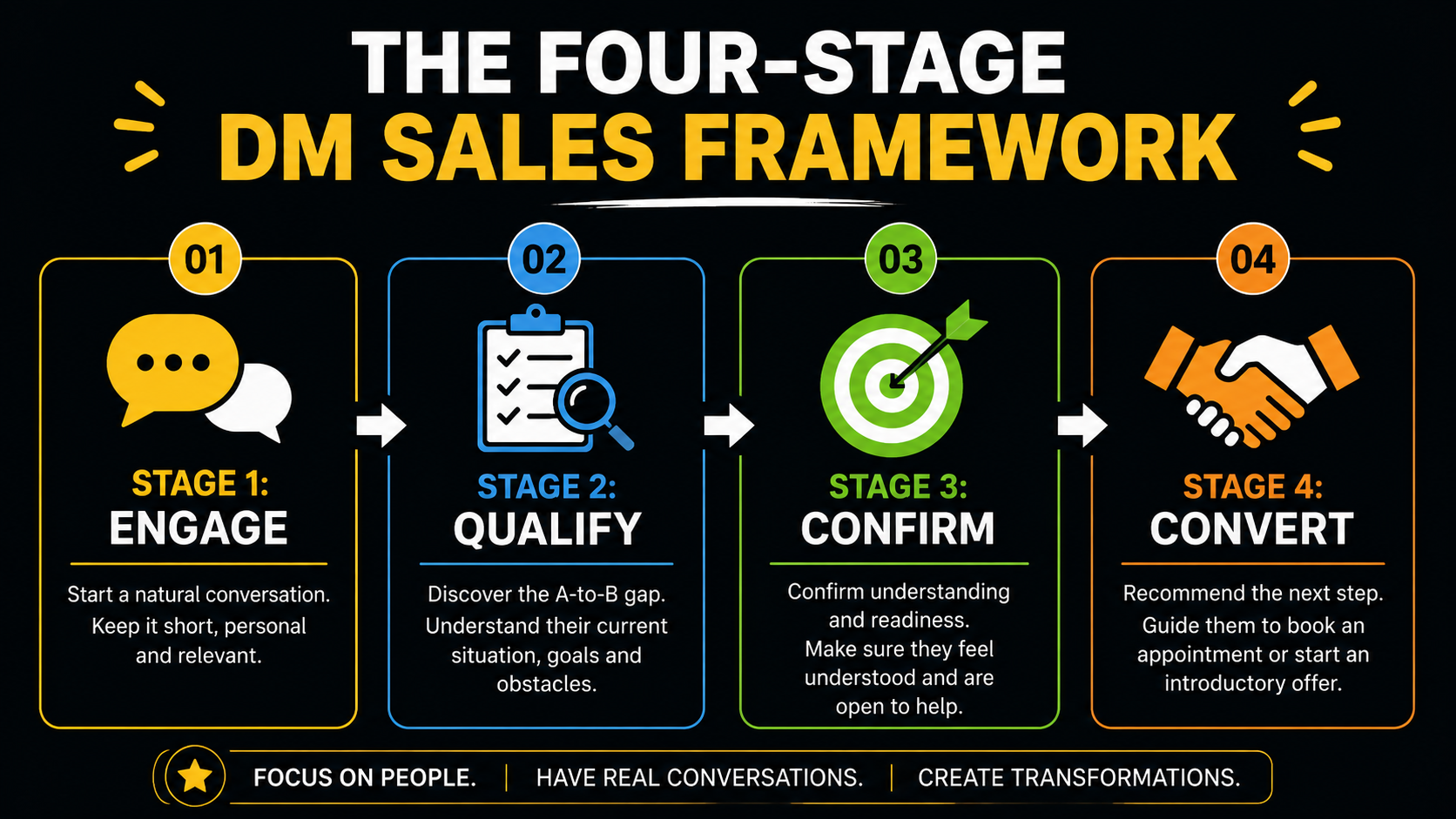
I use a simple four-stage framework:
Each stage has a different purpose, and rushing through them is one of the easiest ways to lose a prospect.
Stage 1: Engage
The goal here isn’t to sell anything.
It’s to begin a natural conversation.
Keep your messages short, personal and relevant to whatever prompted the interaction.
If Julie responded to your poll saying motivation is her biggest barrier, you might ask:
“What’s been the hardest part about staying motivated lately?”
That’s enough. One question.
Give her the opportunity to answer before deciding where the conversation should go.
Selling through chat should feel much closer to speaking with somebody over coffee than filling out an application form. If every message contains three questions and a paragraph of information, the interaction quickly starts feeling like an interrogation.
Stage 2: Qualify
Once the conversation is moving, you need to determine whether this person actually needs your help.
This is your discovery or needs analysis stage.
I use a simple A-to-B gap to think about this.
First, understand A, their current situation.
What are they currently doing for exercise? How often are they training? What are they doing with their nutrition?
Then understand B, where they want to go.
What would they like to achieve? If things went really well over the next six months, what would be different?
Once you understand both points, explore the gap between them.
What’s preventing them from getting there?
How long has that been happening?
What’s most frustrating about it?
This is where questioning becomes an important sales skill.
If you tell someone they have a problem, they can disagree with you. If your questions help them articulate the problem themselves, it becomes real to them.
A useful rhythm during this stage is:
Question → answer → acknowledge → question.
Don’t fire questions at them one after another. Listen to the answer, acknowledge what they’ve told you and, where appropriate, relate it to something you’ve seen before.
If somebody tells you they’d like to lose 5 kilograms, don’t immediately explain your weight-loss programme. Ask how long that’s been important to them or what they’ve tried previously.
Slow the conversation down.
Understanding the problem properly makes the eventual sale much easier.
Stage 3: Confirm
Before recommending anything, I want four green lights.
- Do I clearly understand what this person wants?
- Do I understand what’s preventing them from getting there?
- Do they recognise that something needs to change?
- Have they indicated they’re open to receiving help?
If any of those are missing, I’m probably not ready to present a solution.
This is also where mirroring can be useful. Repeat the important parts of what the prospect has told you in your own words and confirm you’ve understood correctly.
For example:
“Just so I’ve understood, you’d like to lose around five kilos over the next couple of months. You’ve been thinking about doing something for the last six months, and getting back into a consistent routine has been the biggest challenge. Have I got that right?”
People want to feel understood.
When they confirm that you understand their situation, you’ve earned the right to discuss what might happen next.
Stage 4: Convert
At this point, I generally want one of two outcomes.
The first is an appointment. That could be a gym tour, assessment or face-to-face consultation. For an online fitness business, it might be a Zoom consultation.
The second is a simple introductory product such as seven days for $7 or 14 days for $14.
Which path you choose depends on your sales model, but don’t create unnecessary complexity.
If an appointment is the logical next step, explain why and ask permission:
“Based on everything you’ve shared, I think we may be able to help. The next step would be to come in for a gym tour so we can talk through your goals properly and see whether we’re the right fit. Would you be open to that?”
Once they say yes, send the booking link and stay involved until the booking is complete.
Don’t send a link and disappear.
Make sure they can find a suitable time and offer to help if they can’t.
The same applies to an introductory offer. Explain why you think it’s appropriate based on what they’ve told you, ask whether they’d like the link and then help them complete the next step.
You’re reducing friction rather than applying pressure.
What If They Ask About Price?
One of the most common questions you’ll receive early in a DM conversation is:
“How much does it cost?”
There are two bad ways to respond.
The first is immediately sending every membership option, package and price you have. The prospect asked one question and suddenly you’ve given them a menu they don’t understand.
The second is refusing to answer and trying to drag them through your sales process.
That can be equally frustrating.
Acknowledge the question.
You might explain that pricing depends on the level of support they need, then ask permission to understand their situation before recommending the most relevant option.
You’re not hiding the price. You’re creating enough context to give them a useful answer.
The principle here applies to the entire DM sales process: don’t overwhelm people with information they haven’t asked for.
More information doesn’t necessarily make a decision easier.
Often it makes it harder.
Follow-Up Is Part of the Sale
Fitness business owners give up on prospects far too quickly.
A conversation stops and we assume the person isn’t interested.
Maybe they aren’t.
Or maybe their child started crying. Maybe they walked into a meeting. Maybe dinner was burning. Maybe they saw your message, intended to reply and forgot about it ten seconds later.
Follow-up isn’t annoying when there has been genuine interest and it’s handled respectfully.
There are 4 approaches I like.
You can simply reopen the conversation by asking whether they managed to find a suitable booking time.
You can add value by sending something relevant to a problem they mentioned.
You can ask directly whether achieving the goal is still important to them.
Finally, you can close the loop:
“No pressure either way. Is this something you’re still interested in, or should I close the loop for now?”
That gives the prospect control while giving you clarity.
The 15-Minute Daily DM Strategy
There’s a lot in this article, but I don’t want you to finish reading it with another complicated system you’ll implement “when you have time.”
So, here’s the challenge I gave listeners on Profit Made Simple.
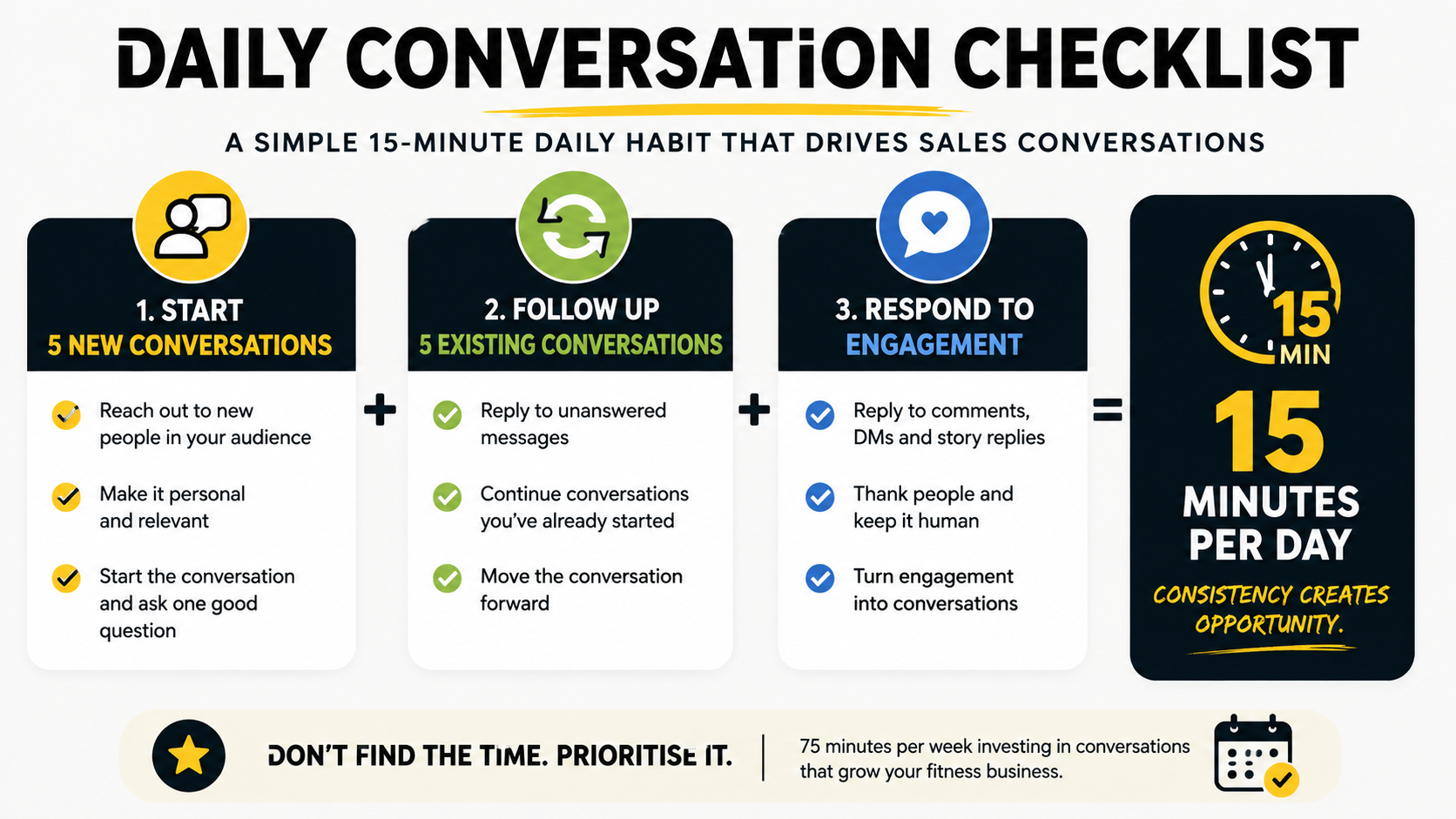
If your goal is to grow your fitness business, set aside 15 minutes every working day, set aside 15 minutes every working day.
During those 15 minutes:
- Start 5 new relevant conversations.
- Follow up 5 existing conversations.
- Respond to everyone who has meaningfully engaged with your content.
That’s it.
Don’t find the time. Prioritise it.
Five days per week means you’re investing 75 minutes into proactively creating and progressing sales conversations.
For many fitness businesses, that will be a far better use of 75 minutes than creating another Reel and hoping somebody eventually clicks the link in your bio.
Frequently Asked Questions
Can you really sell gym memberships through Instagram DMs?
Yes. DMs can be used to understand a prospect’s goals, determine whether your gym can help and move the person towards an appointment or introductory offer. The conversation should be personal and relevant rather than relying on unsolicited sales pitches.
How do gyms get more leads from Instagram?
Create content that encourages interaction rather than only broadcasting information. Polls, questions, useful downloadable resources and simple offers give followers a reason to engage and provide a natural opportunity to start a conversation.
What should I DM a new gym follower?
Keep it simple. Thank them for following and ask whether they’re there primarily for your content or currently working towards a health and fitness goal. Avoid immediately pitching a membership.
How quickly should I try to sell through DMs?
Don’t rush the sale. First understand the prospect’s current situation, desired outcome and what’s preventing them from getting there. Only recommend a next step when you understand their needs and they have indicated they’re open to help.
Should I give gym membership prices through Instagram?
Don’t ignore a direct pricing question. Acknowledge it and provide appropriate context. If you have several services or membership levels, ask permission to understand what the person needs so you can recommend the most relevant option rather than overwhelming them with every price.
How often should gyms follow up with leads?
There isn’t one follow-up frequency that suits every conversation. Follow up when there has been genuine interest and you have a relevant reason to reconnect. You can check on a booking, provide something useful, ask whether their goal remains important or respectfully close the conversation.
Can gym DM conversations be automated?
Some initial actions, such as delivering requested resources or acknowledging specific interactions, can be automated. However, qualification and sales conversations should remain personalised to what the prospect actually says and needs.
Final Thoughts
Social media has given fitness businesses an extraordinary ability to reach people, but reach alone doesn’t grow a business.
Conversations do.
There are probably people sitting inside your audience today who need exactly what you offer. Some are following you. Some are watching your Stories. Some downloaded something six months ago. Some previously enquired but weren’t ready at the time.
You don’t need to aggressively pitch them.
Give them an opportunity to talk.
Then listen.
Ask good questions. Understand where they are, where they want to go and what’s standing between those two points. If you genuinely believe you can help, recommend the appropriate next step and make it easy for them to take it.
Do that consistently for 15 minutes every day and you’ll create far more sales opportunities without becoming the business that everyone avoids in their inbox. It’s a simple approach I consistently teach through my fitness business coaching.
And if you’d like the full Sell by DM Guide I mentioned on the podcast, including the questions and frameworks I use throughout these conversations, message me @coachdanhenderson and ask me to send you the guide.

Leave A Comment