


How to Increase Gym Revenue Without Adding More Members
When fitness business owners talk about growth, the conversation usually goes in one direction. We need more leads, which will hopefully produce more sales, which will eventually give us more members. If we have 150 members today, the obvious goal becomes 200, then 250 and eventually 300.
There is nothing wrong with that approach. Every healthy fitness business needs to be capable of consistently acquiring new clients, but I think we become so focused on acquisition that we overlook a huge amount of opportunity already sitting inside the business.
Your existing members may want more support than they’re currently receiving. Your coaches may have skills and capacity that aren’t being fully utilised. Your facility might be packed at 6am and 6pm but virtually empty for large parts of the day. Meanwhile, your clients could be spending hundreds or thousands of dollars elsewhere on nutrition, supplements, meals, recovery, additional coaching and experiences that could potentially sit within your own ecosystem.
I recently explored this on ‘Profit Made Simple’ with my long-time colleague Kevin Frazier. Kevin and I have worked together for years, and rather than our usual discussion around sales, he spent the episode firing questions at me about a subject I’m particularly passionate about: building additional revenue layers inside a fitness business.
The principle behind the episode was simple. Before automatically deciding you need more members, look at whether you could create more value, revenue and profit from the members, team and facility you already have.

Growth Doesn’t Always Mean More Members
I’ve met plenty of gym owners who believe doubling their business means doubling their membership. If they have 150 members generating $500,000 in annual revenue, the plan is to somehow reach 300 members and get to $1 million.
My first question is usually whether there might be another way.
What if you could grow from 150 members to 200 but substantially increase the amount of value you provide to each client? If those additional services increased average client spend, improved retention and carried strong margins, you could potentially build a significantly larger business without needing anywhere near 300 members.
That changes the economics. You don’t need to generate as many leads, your acquisition costs aren’t under the same pressure, and you don’t necessarily need a much larger facility or team to service twice as many people.
This isn’t an argument against membership growth. It’s an argument for looking at the whole business rather than assuming member count is the only lever available to you.
Why Additional Revenue Streams Matter
I like to think about additional services as revenue layers rather than completely separate businesses.
Your hero product remains at the centre. For a team-training facility, that might be your core membership. For another business it could be semi-private personal training. The idea is then to identify complementary services, products or experiences that make sense around that core offer.
There are 4 reasons I particularly like this strategy. It can increase lifetime client value, make better use of underutilised capacity, allow you to solve more problems for your members and diversify where your revenue comes from.
The important part is that these layers need to make sense. Adding random products because somebody told you supplements have good margins isn’t a strategy. Every layer should align with your clients, your brand, your team and the problems you’re genuinely equipped to solve.
1. Increase the Lifetime Value of Existing Members
One of the most important fitness business KPIs to understand is lifetime client value, sometimes called customer lifetime value. Put simply, how much money does the average client spend with your business from the day they join until the day they leave?
You don’t need complicated software to get an initial estimate. Look at your most recent 20 cancellations and calculate how much each of those clients spent during their entire relationship with you. Find the average and you’ll have a useful starting point, then continue updating the number as more clients leave.
Imagine your core membership is $60 per week, and the average client stays for roughly 9 months. That gives you a lifetime client value a little above $2,000 from the membership itself.
Now consider what happens if that same client also purchases nutrition coaching, participates in a paid challenge, buys meals or supplements through you and attends an occasional retreat or experience. You haven’t acquired another member, but you’ve potentially increased the economic value of the relationship substantially.
There’s another side to lifetime value that matters just as much. Additional services can make the relationship with your business deeper, which may help improve gym member retention. If somebody trains with you, receives nutrition support and participates in your community, there are more reasons for them to remain connected than if their entire relationship is based on attending 3 workouts each week.
The goal isn’t to extract as much money as possible from every member. It’s to ask whether there are additional problems they’re already paying somebody else to solve that you could credibly solve for them.
2. Make Better Use of Your Facility and Team
Most gym and studio owners will immediately understand the problem of underutilised capacity. Your facility can be absolutely pumping before work and again in the evening, while the middle of the day feels like a completely different business.
The rent doesn’t stop between 10am and 3pm. Neither do many of your other fixed costs, so one of the questions worth asking is whether there are services you could deliver during those quieter periods without disrupting the core membership.
Older-adult programs are a good example. We’ve seen businesses within the Fitness Profit community do particularly well serving people aged 60 and above, and one of the advantages is that this demographic can often train during traditional off-peak periods. An 11am or midday session that might attract very little demand from working professionals can be ideal for somebody who’s retired or has greater control over their schedule.
Youth strength and conditioning creates a similar opportunity at the other end of the day. A 4pm session can be difficult to fill with adults but works extremely well for school-aged athletes. You’re taking a part of the timetable that isn’t currently generating much revenue and using the same floor space to serve a different market.
Capacity isn’t only about your facility. Look at your team as well. If you have highly capable coaches spending parts of their working week on low-value administrative tasks, could some of that time be used delivering nutrition coaching, accountability services or another higher-value offering that fits their skill set?
You’ve already invested in the space and the people. The question is whether you’re getting the best possible return from those resources.
3. Solve More Problems for Your Members
Most people initially join a fitness business with a relatively obvious problem. They want to lose body fat, become stronger, have more energy, improve their health or get rid of pain.
Then something interesting happens.
They start training consistently and realise exercise isn’t the entire solution. They begin thinking about nutrition because they want better results. They may want more accountability because staying consistent outside the gym is difficult. They develop friendships within the business and suddenly the social connection becomes an important part of why they attend.
Their needs evolve as the relationship develops.
That’s why I think the best revenue layers start with the client rather than the product. Instead of asking, “What else can we sell?”, ask, “What other problems are our clients trying to solve?”
If they’re already buying prepared meals because eating well during a busy working week is difficult, there may be an opportunity to establish a meal partnership. If they’re walking across the road after every session to buy protein or supplements, perhaps you could make those products available more conveniently. If they want greater accountability, a higher-touch coaching service might make sense.
Community and experiences can fit into the same conversation. One of our clients has created regular social experiences for members, including wine tours. Members pay to attend, so the business creates revenue, but the bigger benefit may be the relationships being built between people who then feel more connected to the community.
When the additional layer solves a real problem or improves the experience, the client wins as well as the business.
4. Diversify Where Your Revenue Comes From
The fourth reason for adding revenue layers is diversification.
If virtually every dollar your business generates comes from one membership, you’re heavily dependent on that single source of revenue. A slower acquisition period, seasonal change or increase in membership suspensions can immediately affect the business.
Additional revenue streams give you more levers to pull. You might have a youth performance intake beginning while general membership sales are quieter. A nutrition program could run at another point in the year, while challenges, products or experiences create additional revenue at other times.
Hybrid services can be particularly useful for businesses with clients who travel regularly. We work with owners in affluent areas whose members might disappear overseas for several weeks during the European summer. Rather than the entire relationship stopping because the member isn’t physically inside the gym, a hybrid coaching or accountability component allows support to continue while they’re away.
The objective isn’t to build 10 businesses inside one gym. It’s to create a small number of complementary revenue sources so the financial health of the business isn’t entirely dependent on one product.
Four Types of Revenue Layers to Consider
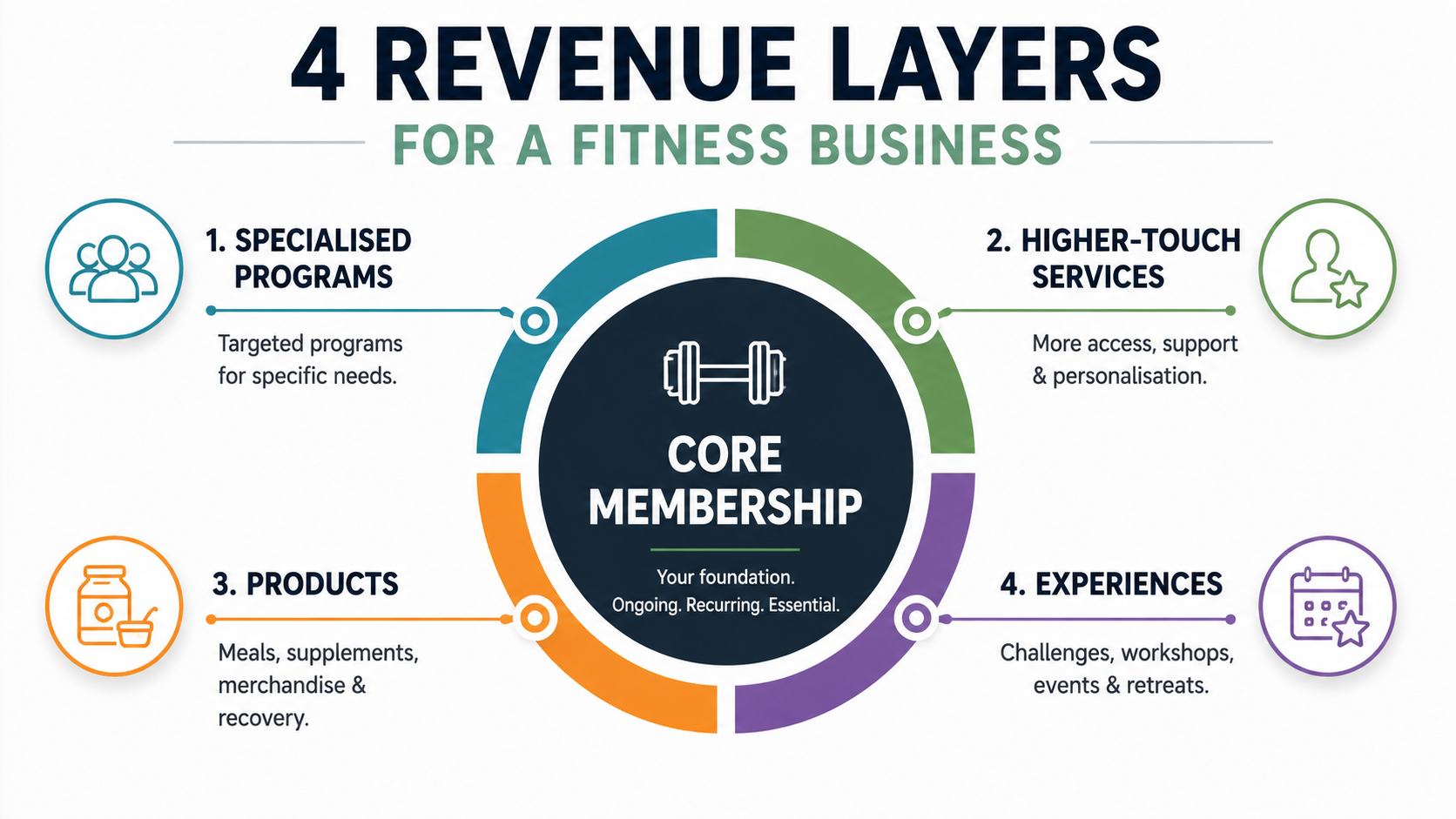
During the episode, I grouped the opportunities into 4 broad categories. This isn’t an exhaustive list, but it’s a useful way to start thinking about what might fit naturally within your business.
Specialised Programs
Specialised programs allow you to use your existing expertise and facility to serve a specific group or solve a more specific problem. Youth athletic development and older-adult strength programs are two obvious examples, but you could also develop programs around particular injuries or populations where your team has genuine expertise.
The advantage is that you’re not necessarily changing what your business fundamentally does. You’re still coaching health, fitness and performance, but you’re packaging that expertise around a more specific need and potentially delivering it during parts of the timetable that currently have spare capacity.
Higher-Touch Services
Some clients will happily pay more for greater access, accountability and personalisation, which is where a clear gym pricing strategy becomes important.This could include nutrition coaching, additional one-to-one contact, hybrid coaching, non-training check-ins or a more concierge-style service.
We’ve seen businesses take this a long way, including highly personalised programs where the coach becomes involved in areas such as the client’s food environment and travel. You don’t need to go anywhere near that far for the model to work. The underlying principle is simply that not every client wants the same level of service, and some people will value a significantly higher level of support.
This also gives you somewhere for clients to progress when the standard membership isn’t enough. Instead of forcing everybody into a premium service, you create an option for the smaller percentage of your market that wants more and is prepared to pay appropriately for it.
Products
Products can include prepared meals, supplements, merchandise and recovery items. These work particularly well when members are already buying the product elsewhere and bringing the behaviour into your facility anyway.
One example from our community involved a client noticing that members were regularly leaving the gym and heading elsewhere to purchase supplements. Rather than simply accepting that, the business looked at bringing a better-aligned product in-house and creating subscription options around it.
Merchandise can also work when it’s treated as something people genuinely want rather than simply sticking your logo on another T-shirt. We’ve seen businesses use quality design, limited releases and a strong community identity to make merchandise part of the brand experience.
The same rule applies to every product layer. It needs to make sense for your people. If it doesn’t improve convenience, results, identity or the overall member experience, there’s probably no reason to add it.
Experiences
The fourth category is experiences. This could include internal challenges, nutrition intensives, workshops, local events or retreats.
When people hear “retreat”, they often imagine flying a group overseas and creating an expensive logistical nightmare. It doesn’t need to look like that. We’ve seen local experiences work extremely well, including day retreats inside the gym where the business brings in specialists, provides quality food and combines practical sessions with workshops and education.
Experiences can create direct revenue, but they also have another benefit. They deepen relationships between members and give people another reason to feel connected to the business beyond the workout itself.
That can make them valuable even before you calculate the profit from the event.
Test Before You Commit
This is probably one of the most important parts of a strong fitness business strategy because it’s where business owners can save themselves a lot of money and unnecessary complexity.
Don’t assume that because an idea sounds good you need to immediately redesign the facility, change the timetable and hire another coach.
Test it.
If you’re considering an older-adult strength program, create a 10 week beta and see whether the market actually wants it. If you’re considering a retreat, start locally before deciding the next one needs to be in Bali. If you want to launch a youth performance program, find the leanest credible version that allows you to test demand before spending heavily on new equipment.
We’re taking a principle similar to the lean startup approach and applying it to a fitness business. Launch something good enough to properly test the idea, collect real feedback, look at the economics and then decide whether it deserves to become a permanent part of your ecosystem.
We’re doing exactly that ourselves with a Fitness Profit leadership retreat. My original ambition was to create an overseas retreat, but we’re starting locally. That allows us to understand demand, delivery, team requirements and the overall experience before making a much larger commitment.
Testing doesn’t mean doing something half-heartedly. You still need to give the idea a genuine opportunity to succeed. It simply means you don’t make a permanent investment before you’ve gathered enough evidence to justify it.
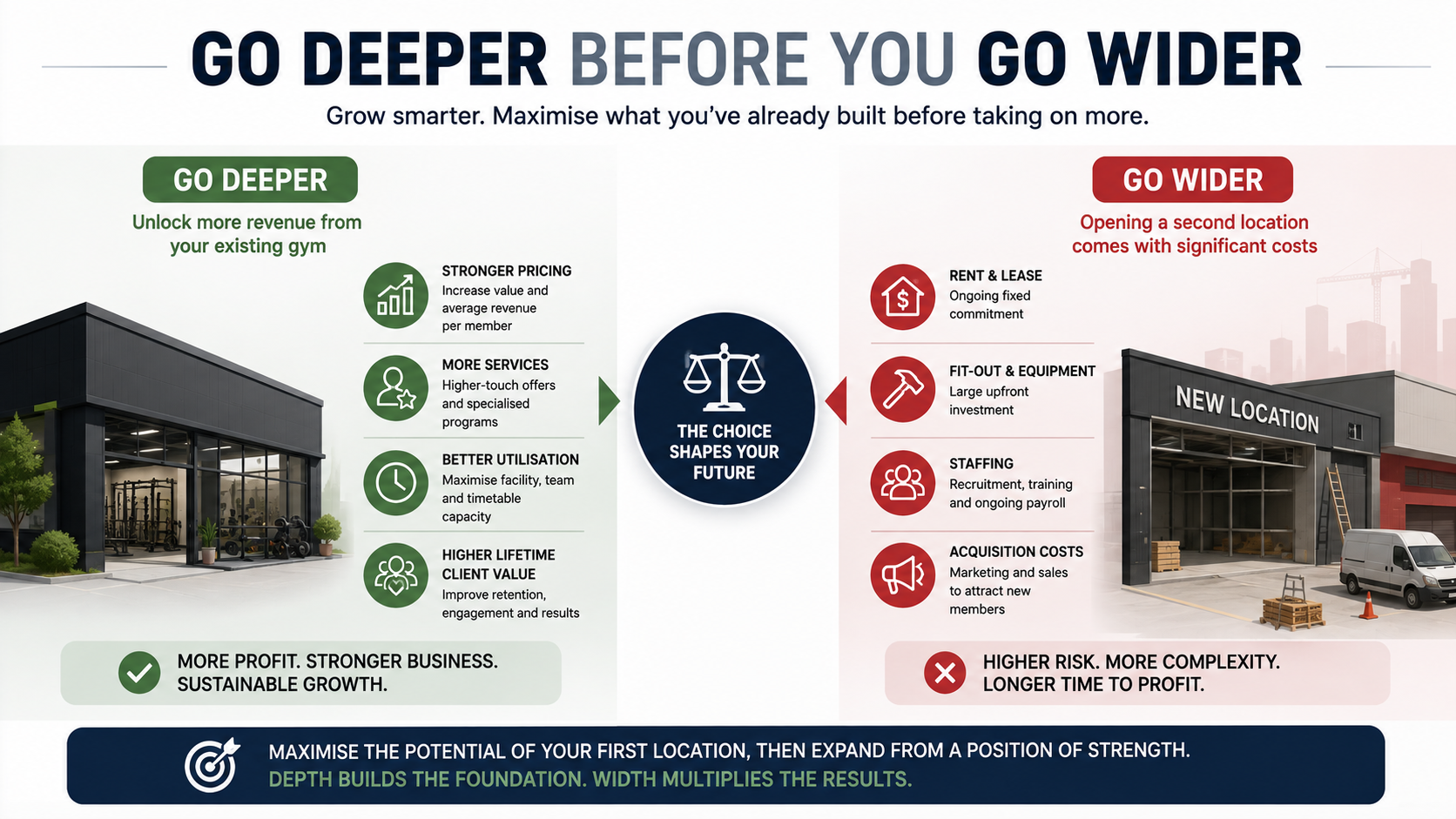
Go Deeper Before You Go Wider
This might be the most important strategic principle in the entire article.
Fitness business owners are ambitious people, and I like that. When it comes to scaling a fitness business, you get the first facility running successfully and naturally start thinking about location number two. Then perhaps location three and four.
I’m not against multi-site ownership. We have plenty of successful multi-site operators in our community, but before signing another lease I would look very closely at how much opportunity is still sitting inside the first location.
Opening another gym is expensive. There’s another lease, fit-out, utilities, insurance, equipment, staffing and management structure before you even start thinking about acquiring enough members to make the location viable.
What if there was another way to grow first?
If you have 150 members and want to double the business, perhaps the answer isn’t immediately finding another 150. Maybe it’s growing to 200 members while improving pricing, packaging, lifetime client value and the product ecosystem to a point where the business produces revenue and profit that previously would have required 300.
That’s what I mean by going deeper before you go wider.
Before taking on another facility, ask whether you’ve fully utilised the space, team, client relationships and expertise you’ve already paid to create.
Why Profit Matters More Than Member Count
One of the reasons owners become fixated on membership numbers is that they’re visible and easy to compare. Saying you have 300 members sounds better than saying you have 200, just as saying you’ve built a million-dollar business sounds impressive from the outside.
Neither tells me how good the business actually is.
I’d rather own a business with 200 members producing excellent margins, strong retention and healthy profit than a 300-member facility where the additional revenue is being swallowed by staffing, acquisition and operating costs.
This is where revenue layers can change the equation. If additional services increase lifetime value and carry attractive margins without requiring a proportional increase in overhead, the business can become more profitable without becoming dramatically bigger or more complicated.
Revenue is important, but revenue without understanding margin can be misleading. Ultimately, it’s the profit left after delivering the service that gives you options as an owner.
Don’t Add Everything at Once
There is an obvious danger with everything I’ve just written.
You could finish this article excited about youth programs, training older adults, nutrition coaching retreats, supplements, meals, merchandise and high-touch coaching, then decide you’re going to launch all of them next month.
Please don’t.
This strategy works when you stack revenue layers one at a time.
I use the analogy of spinning plates. You put the first plate on the stick and spend enough time getting it spinning properly. Only once it’s stable do you move to the next one. If you try to spin six new plates at the same time, there’s a good chance several end up on the floor.
Your core membership might be the first plate. Once that’s operating effectively, you introduce semi-private training. You test it, refine the systems, make sure the team can deliver it and confirm that it’s profitable. Later, you might introduce a challenge, nutrition service or product layer.
For most fitness businesses, adding one or perhaps two meaningful revenue layers in a year is plenty. Each one needs time to be tested, systemised and refined before you introduce another.
There’s an important tension here between diversification and simplicity. The objective is to build a richer business, not a messier one.
Frequently Asked Questions
How can a gym increase revenue without getting more members?
A gym can increase revenue from its existing membership by improving pricing, increasing client lifetime value and adding complementary services such as nutrition coaching, semi-private training, specialised programs, products or experiences. The best opportunities solve problems members already have rather than simply giving them more things to buy.
What are good additional revenue streams for a gym?
Potential gym revenue streams include youth performance programs, older-adult strength training, semi-private coaching, nutrition services, hybrid coaching, prepared meals, supplements, merchandise, paid challenges, workshops and retreats. The right options depend on the gym’s target market, expertise, capacity and brand.
What is client lifetime value in a fitness business?
Client lifetime value is the total amount an average client spends with your business during their entire relationship with you. A simple way to estimate it is to review recent cancellations, calculate how much each person spent before leaving and find the average.
Should I add nutrition coaching to my gym?
Nutrition coaching can be a logical additional service if your members need it and your business has appropriately qualified people and systems to deliver it. It should improve the member’s results and fit naturally with your core service rather than being introduced purely as another source of revenue.
How can I make better use of my gym during off-peak hours?
Look for markets that naturally prefer different training times. Older adults may have greater availability during late mornings and the middle of the day, while youth strength and conditioning can work well immediately after school. The goal is to generate additional revenue from space you’re already paying for without reducing the experience of existing members.
Should I open a second gym or grow my existing location first?
Before opening another location, assess whether the existing facility has untapped capacity and profit potential. Improving pricing, utilisation, retention and client lifetime value may allow you to significantly grow profit before taking on the cost and complexity of another facility.
How should I test a new gym service?
Start with a defined beta program rather than making an immediate permanent commitment. Establish the audience, duration, price and desired outcome, then measure demand, client results, delivery requirements and profitability. Use what you learn to refine the service before deciding whether it should become permanent.
How many additional revenue streams should a gym have?
There isn’t an ideal number that applies to every business. The goal should be a small ecosystem of complementary services that can be delivered consistently and profitably. Adding one or two meaningful revenue layers per year is often more manageable than launching several at once.
Final Thoughts
Fitness business growth doesn’t always need to mean finding more people.
Sometimes the biggest opportunity is sitting inside the business you’ve already built. You have clients who trust you, a team with skills, a facility you’re already paying for and a community of people spending money on health and fitness problems beyond the service you currently provide.
The opportunity is to look at those assets differently.
Ask where your members are currently spending money outside your business and whether there are areas where you could genuinely provide a better or more convenient solution. Look at the hours when your facility is underutilised and the skills within your team that aren’t being fully used. Most importantly, look at your current location and ask whether you’ve really maximised its potential before assuming growth requires another lease and another 150 members.
Then choose one opportunity.
Test it properly, refine it, make sure it’s profitable and build the systems required for it to operate consistently. Only when that plate is spinning should you reach for the next one.
Over time, you create an ecosystem around your core service where members receive more support, stay connected for longer and potentially spend more because you’re solving more of the problems they genuinely care about.
That’s a much more interesting growth strategy than simply saying, “We need more leads.”
And in many fitness businesses, it can also be a much more profitable one. If you need support putting these strategies into practice, our fitness business coaching can help.



Leave A Comment